Current Price: $239 On Amazon
Best for: Stone fabrication, countertop polishing, concrete prep
⭐ Key win: 23% more coverage per pass + runs 4.5" discs too
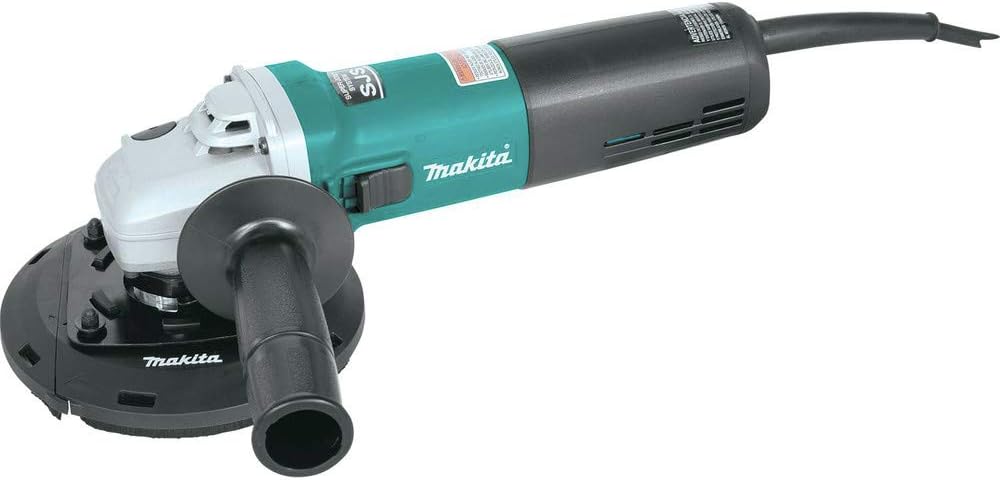

Current Price: $219 On Amazon
Best for: Tile work, tight spaces, precision grinding
⭐ Key win: Widest 4.5" disc selection at any hardware store
Introduction
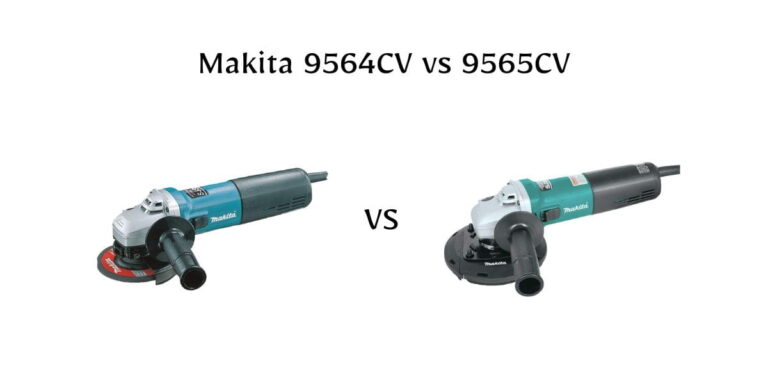
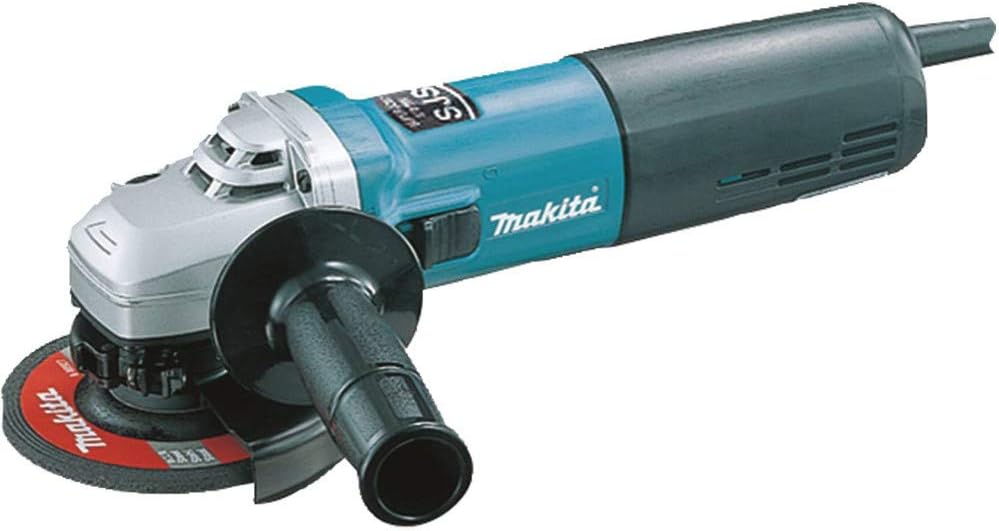
You already know these two grinders are nearly identical. You’ve seen the spec sheets. You’ve read at least two articles that told you the 9564CV is 4.5 inches and the 9565CV is 5 inches, showed you a comparison table, and then told you to “buy the 4.5″ for tight spaces and the 5″ for larger surfaces.”
That advice isn’t wrong. It’s just incomplete in the way that actually matters — because it leaves out the stuff that real buyers are asking about in forums and Q&A sections that nobody bothers to answer.
This article answers those questions in plain language. No padding. No fake “I’ve used both for years” claims. Just the real breakdown, drawn from contractor forums, professional stone fabricator communities, Makita’s own technical documentation, and the kind of hands-on pattern that emerges when enough real users weigh in over enough years.
Table of Contents
TL;DR
The 9564CV (4.5″) and 9565CV (5″) share the same motor, electronics, and clutch — the only real difference is disc size. The 9565CV covers 23% more surface per pass, runs 4.5″ discs too, and costs just $9 more, making it the better buy for stone and countertop work. If you need precision in tight spaces or want the widest disc availability at hardware stores, go with the 9564CV.
Related Articles:
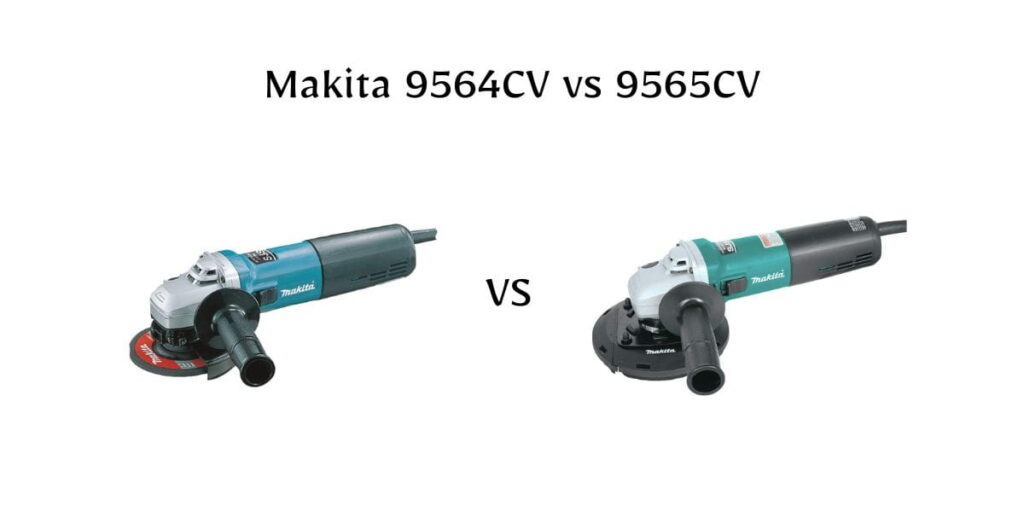
At-a-glance: Makita 9564CV vs 9565CV
| Features | Makita 9564CV | Makita 9565CV |
|---|---|---|
| Price | $219 | $228 |
| Disc Size | 4.5" | 5" |
| Motor / Amps | 13A | 13A |
| Speed Range | 2,800–10,500 RPM | 2,800–10,500 RPM |
| Weight | 5.3 lbs | 5.2 lbs |
| SJS™ Clutch | ✓ | ✓ |
| Runs 4.5" Discs | ✓ | ✓ |
| Runs 5" Discs | ✗ | ✓ |
| Best For | Tile, tight spaces, precision cuts | Stone fab, countertops, open surfaces |
| Verdict | Precision pick | Value & versatility pick |
| Where To Buy | Check On Amazon | Check On Amazon |
First, Let’s Get the Obvious Part Out of the Way
Yes, these are the same tool with a different disc.
That’s not a simplification — it’s the literal engineering reality.
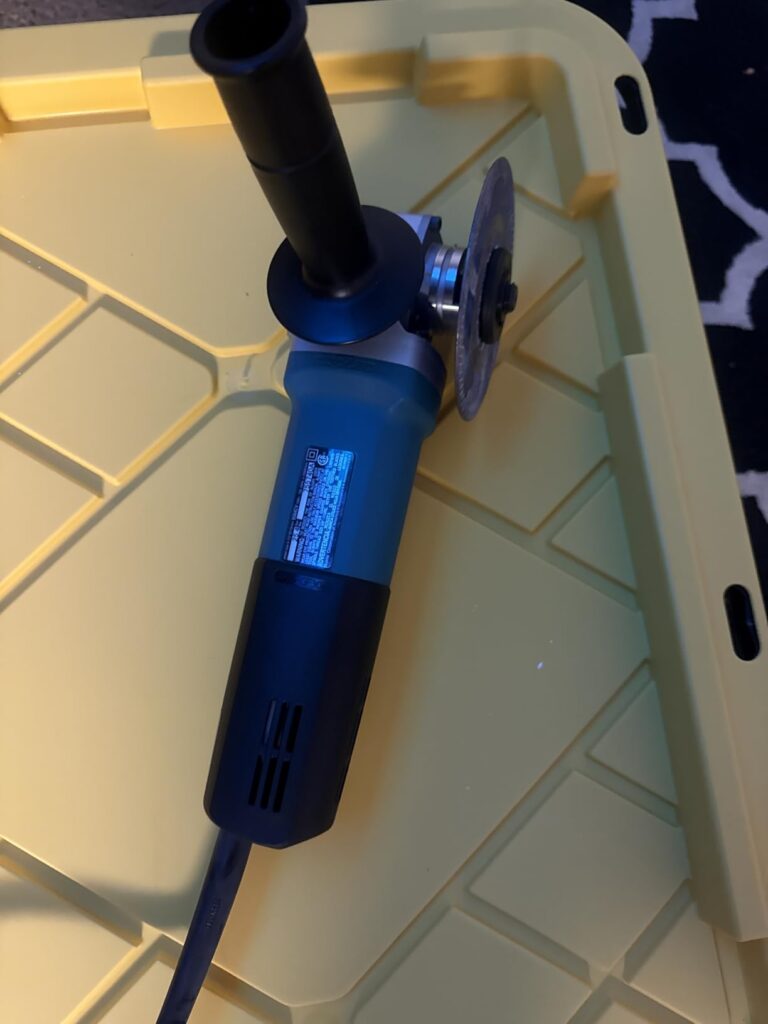
The only functional difference between these two grinders is the maximum disc diameter: 4.5 inches on the 9564CV, 5 inches on the 9565CV.
Now here’s where it gets interesting — because once you understand what that single difference means across real work scenarios, the choice stops being confusing. It becomes obvious. But which choice is obvious depends entirely on what you’re doing with the grinder, and that part is what most comparisons skip.
The Disc Size Question — What It Actually Changes in Real Work
This is the section most comparison articles get wrong by oversimplifying.
“Bigger disc covers more surface area” is true. But let’s talk about what that means in the specific contexts where people actually use these grinders.
Stone Fabrication and Countertop Work
This is the dominant use case for both models. Contractors polishing granite countertops, fabricators working marble slabs, tile installers bullnosing travertine edges — this is the professional core audience for the 9564CV and 9565CV.
For this work, the 5″ model has a genuine productivity advantage that compounds over a full workday. A 5″ polishing pad covers approximately 19.6 square inches per pass. A 4.5″ pad covers approximately 15.9 square inches. That’s roughly 23% more surface coverage per identical pass.
On a standard kitchen countertop installation, this doesn’t sound dramatic. But granite fabricators working production volumes — multiple countertops per day, hours of continuous polishing — report that the larger disc meaningfully reduces fatigue not because it’s lighter, but because it accomplishes more work per movement. Fewer passes per linear foot means fewer total arm movements. Over a six-hour fabrication day, that adds up.
For this reason, the professional stone and fabrication community has developed a strong lean toward the 9565CV specifically. Specialty stone suppliers position it as the tool for this work. It’s not arbitrary preference — it’s efficiency math.
Tile Work and Precision Grinding
Here the calculation shifts toward the 9564CV.
Tile work involves cutting precise shapes, bullnosing edges at consistent angles, and working in areas where control matters more than coverage speed. A 4.5″ disc gives the operator a smaller, more controllable cutting radius. The lower total disc mass also means slightly less rotational inertia to manage when you’re making fine adjustments.
For someone doing a single bathroom tile install, or bullnosing a border, or cutting curves around outlets and fixtures — the 9564CV is the more comfortable tool. The precision advantage isn’t dramatic, but it’s real, and it’s the reason why even contractors who own the 9565CV for countertop work will sometimes keep a 9564CV on the job for detailed tile cuts.
Metal Grinding and Fabrication
Both tools work for metal. Neither is optimized for it — these are stone-class grinders first, and the SJS clutch and variable speed are built for that context. But for occasional metal work like cleaning welds, removing rust, or cutting rebar, both perform the same job with identical results.
If metal grinding is your primary use case, neither model is the ideal choice and the disc size distinction becomes irrelevant. A fixed-speed grinder without the premium SJS system will serve metal work better and save you money.
Concrete and Floor Work
For surface grinding on concrete — prep work, removing coatings, leveling — the 5″ model offers more efficiency for the same reasons as stone fabrication. More coverage per pass. The 9565CV is genuinely more practical here, and it’s why concrete finishing and polishing suppliers stock it specifically.
The Disc Availability Question (Answered Honestly)
This question shows up in contractor forums repeatedly, and no comparison article bothers to address it directly.
“Will I have trouble finding 5″ discs?”
The honest answer is: slightly, yes, in certain contexts.
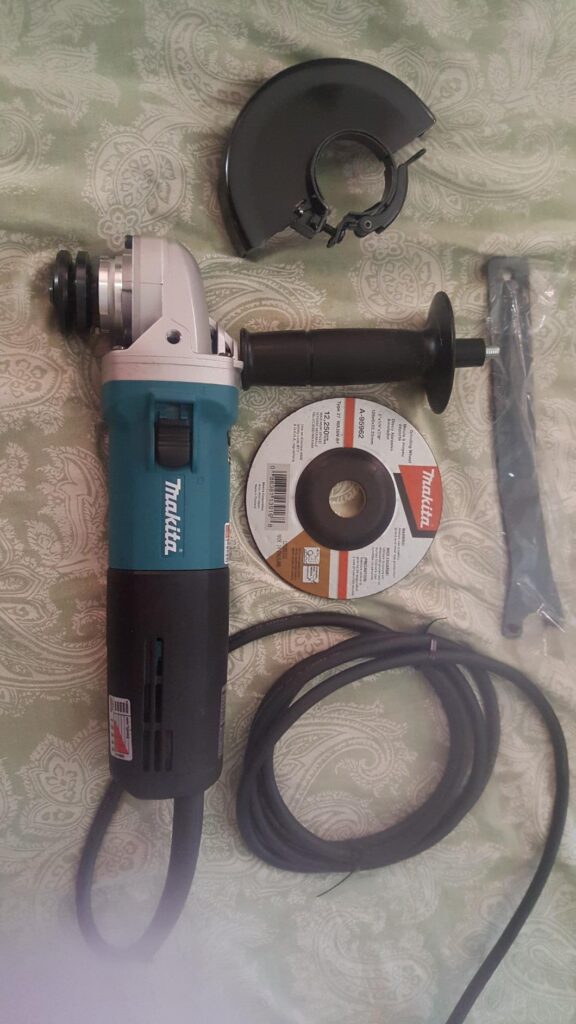
4.5″ (115mm) is the global standard for angle grinder consumables. Walk into any hardware store, any auto parts store, any big-box retailer, and you will find 4.5″ cutting discs, flap discs, grinding wheels, and polishing pads. The selection is enormous and the prices are competitive because of volume.
5″ (125mm) discs are widely available but not universally so. At a Lowe’s or Home Depot in a smaller market, the 5″ section will be thinner than the 4.5″ section. General-purpose cutting discs and grinding wheels in 5″ are easy to find. But if you need specialized products — specific grit diamond polishing pads, particular backing systems, niche abrasive profiles — the 5″ selection is narrower at general retailers.
The exception: specialty stone and tile suppliers. At BB Industries, Diamond Tool Store, GranQuartz, and similar stone trade suppliers, the 5″ consumables selection is excellent and often better-curated for the specific applications (polishing stone, grinding granite) that the 9565CV is built for. If you’re buying from these suppliers anyway — which most stone fabricators are — disc availability is not a concern.
The practical conclusion: If your work takes you to stone suppliers, buy the 9565CV. If your work is more general and you’re sourcing consumables from standard hardware stores, the 9564CV’s disc availability is genuinely more convenient.
The SJS™ Clutch — Why It Matters More Than the Disc Size for Longevity?
Both models have it. But since most comparison articles mention SJS™ without explaining what it actually does, let’s fix that — because this is the feature that makes the 9564CV and 9565CV worth the $219–$228 price point over cheaper alternatives.
SJS stands for Super Joint System. It’s Makita’s mechanical clutch system, and it solves a specific failure mode that destroys angle grinders.
When a grinding disc catches — binding in a cut, snagging on an edge, grabbing on a surface — the disc tries to stop suddenly while the motor continues spinning. On grinders without a clutch system, this force transfers directly into the gears. The gears absorb the shock. Over time, this causes gear wear. In severe cases, it strips gears instantly.
The SJS system is a mechanical clutch in the drive shaft. When the disc catches and the rotational load spikes beyond a threshold, the clutch automatically slips — decoupling the motor from the disc momentarily. The energy of the catch dissipates through the slip rather than through the gears.
The result: the gears are protected from the most common cause of grinder failure. Contractors who have run both SJS and non-SJS grinders report dramatically longer gear life on the Makita, particularly in stone work where the disc is constantly in contact with hard material and catch events are frequent.
This is why granite fabricators who own a dozen grinders report never burning one up. The clutch is doing its job constantly, invisibly, in every session.
For buyers choosing between the 9564CV and 9565CV, the SJS system is one reason to choose either of them over competing grinders at lower price points. It’s not a differentiator between these two models — they both have it — but it’s a reason to take the Makita premium seriously rather than shopping purely on disc size.
The Variable Speed Dial — Five Stages, and Why Each One Exists
Current Price: $239 On Amazon
Best for: Stone fabrication, countertop polishing, concrete prep
⭐ Key win: 23% more coverage per pass + runs 4.5" discs too
Both grinders run the same 2,800–10,500 RPM range through a 5-stage dial. Here’s what those stages are actually for — because “match the speed to the application” is not useful advice without context.
Stage 1 (approximately 2,800–3,500 RPM) — Delicate polishing on finished stone, final polish passes on marble, soft material grinding. Running polishing pads on finished granite at high speed generates too much heat and can burn the finish. Low speed keeps pad temperature manageable.
Stage 2 (approximately 4,000–5,500 RPM) — Mid-stage polishing, initial passes on soft stone like travertine and limestone. These materials are more porous and respond well to slower, more controlled abrasion.
Stage 3 (approximately 6,000–7,500 RPM) — General grinding and material removal on medium-hardness surfaces. The most common working range for concrete prep and intermediate stone work.
Stage 4 (approximately 8,000–9,000 RPM) — Aggressive grinding on hard stone, initial stock removal on granite. Used when you need cutting speed and material isn’t as temperature-sensitive.
Stage 5 (approximately 9,500–10,500 RPM) — Maximum speed for cutting discs and aggressive metal work. Full speed for applications where velocity matters more than heat control.
The constant-speed electronics are important here: the grinder’s control circuit monitors load and automatically increases power to maintain the set speed when you push harder into the material. You’re not manually compensating for load — the tool does it. This is particularly valuable in stone polishing, where consistent speed directly affects polish quality.
Soft start (both models) means the disc spins up gradually over roughly one second rather than jumping to full speed. This protects gears at startup and prevents the wrist-jolting reaction that characterizes cheaper variable-speed grinders.
The Labyrinth Construction — What It Is and Why Stone Workers Care
The “labyrinth construction” mentioned in Makita’s specs is worth understanding, because it directly affects how long these grinders survive in the environments where they’re most commonly used.
Stone grinding and polishing creates silica dust — fine, highly abrasive particles that destroy bearing surfaces and motor windings. This is why cheap grinders fail so quickly in stone work: the dust infiltrates and causes progressive damage.
Makita’s labyrinth construction creates a series of interlocking channels inside the housing — a physical maze that dust particles must navigate to reach the motor. Combined with the zig-zag varnish (a sealing compound applied to motor windings and bearings that hardens into a protective barrier under heat and rotation), the motor is effectively isolated from the working environment.
The consequence in real-world use: these grinders survive conditions that kill other tools. Granite fabricators who run these machines all day in heavy dust environments report years of service life. The labyrinth isn’t a marketing term — it’s an engineering solution to the specific problem of running an electric motor in stone dust.
Again: both the 9564CV and 9565CV have this. It’s not a differentiator between models. But it’s why both tools justify their price, and why buying a cheaper alternative for stone work usually results in a more expensive decision over time.
What Real Users Actually Say (Forum and Community Intelligence)
Current Price: $219 On Amazon
Best for: Tile work, tight spaces, precision grinding
⭐ Key win: Widest 4.5" disc selection at any hardware store
Beyond spec sheets, there’s a pattern that emerges when you look at what real contractors and fabricators say about these tools across forums, Q&A sections, and trade communities.
The most repeated positive: Raw durability. Contractors describe running the 9565CV all day in stone dust without failure, year after year. The phrase “never burned one up” appears repeatedly from users who have gone through multiple other brands. The SJS and labyrinth construction together produce a tool that survives commercial use.
The most repeated complaint: The spindle lock is considered weak relative to the rest of the tool. The mechanism for locking the spindle while changing discs gets mentioned as the soft point in an otherwise very solid tool. This is a minor operational annoyance rather than a reliability failure — the spindle lock doesn’t affect performance, only disc-change convenience.
The most useful real-world observation: Multiple contractor voices confirm that the 9564CV and 9565CV are functionally identical. A tile forum contributor who owned the 9564CV sent it to a colleague, who then bought his own — and chose the 9565CV instead. His reasoning: “Everything seems to be the same on the two. The 5″ was cheaper at the time, and the bigger disc just made sense for what I was doing.” The shared-internals story isn’t a theory — it’s confirmed by real user experience comparing both tools directly.
The warning worth heeding: A minority of users report “hunting” behavior — a rhythmic sound suggesting motor instability — after extended use. This appears isolated to specific units rather than being a systemic design issue, and it emerged in an older-vintage discussion. Makita’s quality control on these models has a strong long-term track record. But it’s worth noting that any motor-brush tool will eventually need brush replacement, and the CB-340 carbon brushes compatible with both the 9564CV and 9565CV are a standard maintenance item, not a defect response.
The Grip and Ergonomics Reality
One thing that doesn’t come up in spec sheets but does come up in hands-on use: both the 9564CV and 9565CV have a larger grip circumference than lighter-duty Makita models.
This matters for users with smaller hands, or for users transitioning from a basic 6-amp grinder. The body diameter is noticeably thicker than budget alternatives. Users who handle both at retail before buying consistently comment on this — the tool feels substantial and solid, but it’s not a compact grip.
The side handle installs on either side, which accommodates both right- and left-handed operators. This is standard on professional grinders but worth confirming, since some lower-cost models only allow right-side handle installation.
For extended use — which is the primary context for buying a variable-speed SJS grinder rather than a basic fixed-speed model — the grip circumference becomes less of an issue as users adapt, and the lock-on switch (which holds the trigger in the on position without continuous pressure) reduces hand fatigue significantly during long polishing sessions.
The Honest Verdict: A Decision Tree, Not a Ranked List
Most comparison articles try to declare a winner. This one won’t, because these tools don’t compete — they serve different primary use cases within the same professional user segment.
Here is the honest decision framework:
You should buy the Makita 9565CV ($228) if:
Your primary work is stone fabrication, granite countertop polishing, or concrete surface prep. You source consumables from stone trade suppliers like BB Industries, GranQuartz, or Diamond Tool Store. You’re working on open, flat surfaces where coverage speed translates to productivity. You do production-volume work where fewer passes per session compounds into meaningful time savings. You want the tool that the professional stone and fabrication community has converged on as the default.
You should buy the Makita 9564CV ($219) if:
Your primary work is tile installation, precision grinding, bullnosing in tight spaces, or work that requires a tighter cutting radius and more controlled disc behavior. You source consumables from general hardware retailers and want the widest possible disc selection at lowest per-unit cost. You’ll be working in confined spaces — under cabinets, in corners, around fixtures — where the smaller disc footprint gives you a maneuverability advantage. You do occasional or project-based work rather than production-volume fabrication.
One Last Thing: The Disc Size Is Not Permanent
This deserves its own section because it’s not obvious.
The 9564CV is a 4.5″ grinder. The 9565CV is a 5″ grinder. But the guard on both is tool-less adjustable, and the spindle thread (5/8″-11 UNC) is identical.
You can run a 4.5″ disc on the 9565CV. The guard adjustment accommodates smaller disc sizes. This isn’t unconventional — it’s standard practice. Stone fabricators who primarily use 5″ polishing pads will sometimes switch to a 4.5″ cutting disc for specific cuts without changing tools.
The reverse is not possible: you cannot run a 5″ disc on the 9564CV. The guard won’t accommodate it, and attempting to do so is unsafe.
The practical implication: the 9565CV is actually the more versatile tool by disc size. It can run 4.5″ consumables (giving you access to the full 4.5″ selection when needed) and 5″ consumables (giving you the coverage advantage for polishing). The 9564CV is locked to 4.5″ and smaller.
FAQs
Q: What is the actual difference between the Makita 9564CV and 9565CV?
A: Disc size only — 4.5″ vs 5″. The motor, speed range, SJS clutch, and all electronics are identical on both.
Q: Is the 9565CV worth the $9 extra?
A: For stone and countertop work, yes — larger disc, more coverage, and it can still run 4.5″ discs. For tight tile work, save the $9 and get the 9564CV.
Q: Can the 9565CV use 4.5″ discs?
A: Yes. The 9565CV can run both 4.5″ and 5″ discs. The 9564CV is locked to 4.5″ and smaller only.
Q: Which one do professional stone fabricators prefer?
A: The 9565CV. The larger disc covers more surface per pass, which adds up to real time savings on production countertop work.
Q: Are 5″ discs harder to find than 4.5″?
A: Slightly, at general hardware stores. At stone trade suppliers (BB Industries, GranQuartz, etc.), 5″ consumables are well-stocked and purpose-built for this tool.
Q: What does the SJS™ clutch actually do?
A: It automatically decouples the motor from the disc when the wheel catches or binds, protecting the gears from shock damage — the main reason these grinders outlast cheaper alternatives.