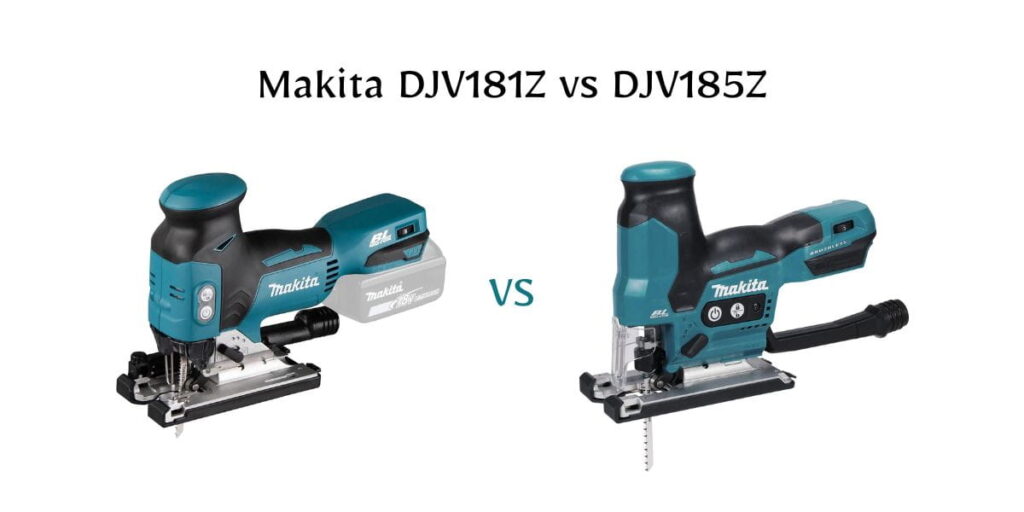
Current Price: $369
Best for: Heavy cutting, production work, noise-sensitive environments
Key Advantages: 3,500 SPM max speed, 78dB quiet operation, dual LED lights, 390W power output


Current Price: $323
Best for: Precision work, all-day comfort, budget-conscious buyers
Key Advantages: Better ergonomics, refined grip design, improved control placement, $46 savings
Introduction
Here’s something weird: The Makita DJV185Z costs $323 on Amazon, while the older DJV181Z costs $369.
That’s backwards, right? Newer models are supposed to cost more.
But this isn’t a mistake. And it’s not about one being “better” than the other.
This price difference reveals something most people completely miss when shopping for barrel-grip jigsaws—and understanding it will save you from buying the wrong tool.
Table of Contents
TL;DR
The DJV185Z ($323) costs less but has better ergonomics—perfect for precision work and all-day comfort. The DJV181Z ($369) costs more because it’s 7dB quieter, 500 SPM faster, and built for heavy-duty cutting. Neither is “better”—they solve different problems.
Related Articles:
At-a-glance: Makita DJV181Z vs DJV185Z
| Features | DJV181Z | DJV185Z |
|---|---|---|
| Price | $369 | $323 |
| Stroke Length | 26mm | 23mm |
| Max Speed | 3,500 SPM | 3,000 SPM |
| Noise Level | 78 dB | 85 dB |
| LED Lights | Dual | Single + reduction |
| Ergonomics | Boxy grip | Refined grip |
| Best For | Speed & power | Comfort & value |
| Where To Buy | Check On Amazon | Check On Amazon |
The Question Nobody’s Asking (But Should Be)
When someone searches “Makita DJV181Z vs DJV185Z,” they’re not really asking about stroke lengths or motor specs.
They’re asking: “Which one won’t leave me frustrated six months from now?”
Because here’s what actually happens: You buy based on price or model number. Then three months later, you’re either loving every cut or silently cursing Makita every time you pull the trigger.
The difference? Most people don’t realize these aren’t competing models—they’re tools designed for completely different frustrations.
Problem #1: “This Soft-Start Thing Is Driving Me Crazy”
Let’s talk about the elephant in the workshop.
The DJV181Z has a soft-start feature that cannot be disabled. Ever. You press the button, and the saw ramps up from 800 SPM to full speed over about half a second.
For some people, this is perfect. For others, it’s absolutely maddening.
When Soft-Start Becomes a Problem?
You’re cutting a tight curve in 3/4″ plywood. You need to ease into the cut, feel the blade settle, then punch it. But the DJV181Z decides when you get full power. Not you.
Or you’re doing delicate work—maybe cutting a curve in acrylic or thin veneer. You need to start at 100-200 SPM and stay there. The DJV181Z says “nope, 800 minimum.”
Forum users have been vocal about this: “The only thing I’m not crazy about is how it always does soft start. Other brands give you the option.”
The DJV185Z Solution (Maybe)
Here’s where it gets interesting: YouTube videos suggest the DJV185Z might have a disable function for soft-start.
I can’t 100% confirm this because Makita’s official specs don’t mention it. But if you’re someone who values instant throttle response, this alone might be worth investigating before you buy.
Bottom line: If you hate the idea of a tool controlling your starting speed, the 185 deserves a closer look.
Problem #2: “My Hand Hurts After 30 Minutes”
This one surprised me during research.
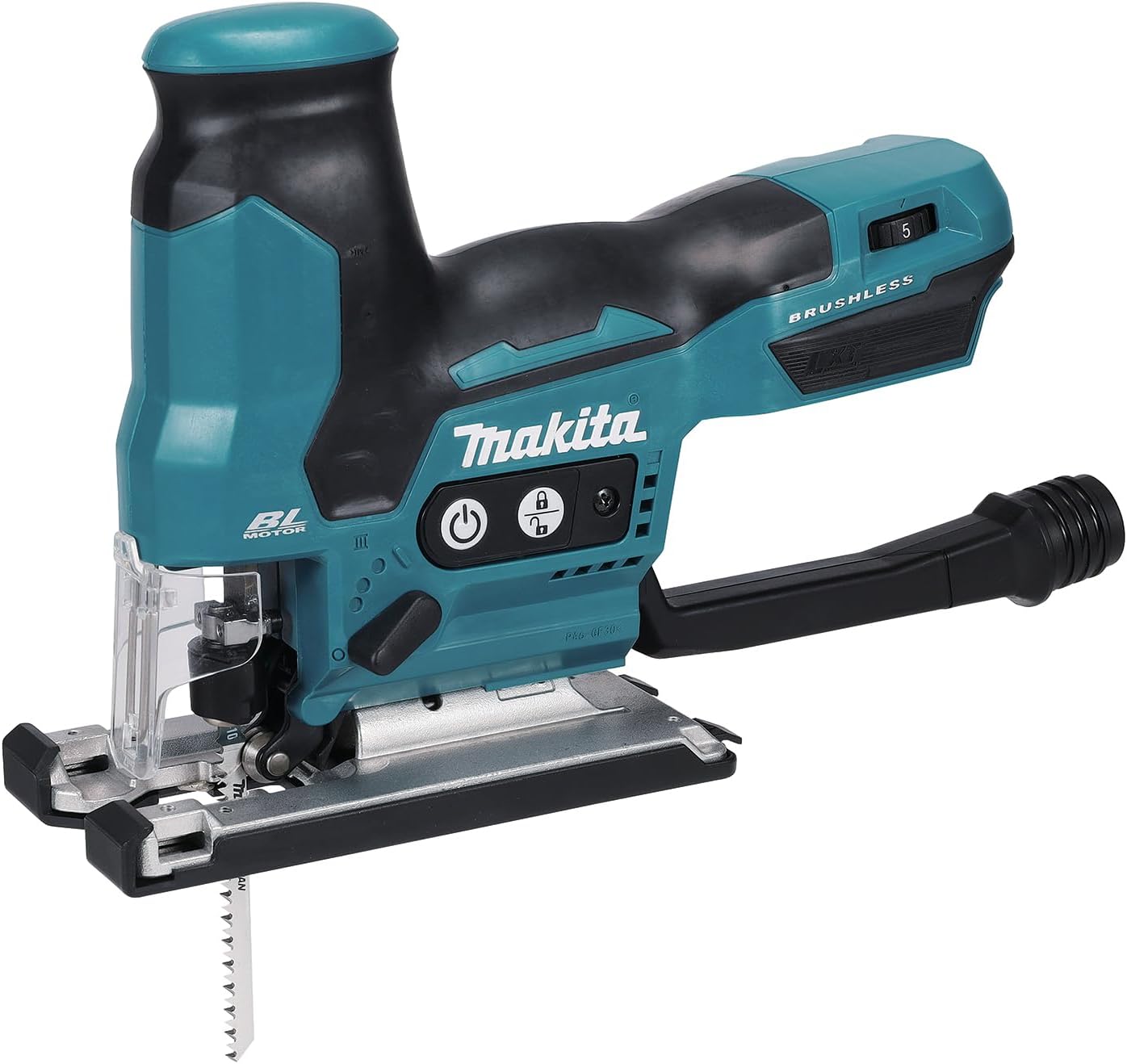
The DJV181Z has a design quirk that matters way more than the spec sheet suggests. Instead of maintaining the curved barrel grip throughout, Makita made the battery compartment section rectangular and boxy to accommodate the variable speed dial.
A professional reviewer put it bluntly: “I have average size hands and the corners of the battery compartment dug into the heel of my hand.”
This isn’t about being picky. This is about whether you can use the tool for two hours without your palm cramping up.
The Hand Comfort Reality Check
If you’re doing production work—installing cabinets, cutting countertops, running through sheet goods all day—hand fatigue isn’t a small thing. It’s the difference between finishing strong at 5 PM or switching to a different tool after an hour because your palm is killing you.
Consider this: Pick up any barrel-grip tool at a hardware store and hold it for 2-3 minutes. That slight pressure point that seems minor? Multiply that by 4 hours of cutting. That’s your decision right there.
The DJV185Z redesigned the grip area. Better control placement. More rounded contours. Less “digging into your palm” geometry.
Problem #3: “I Can’t See What I’m Cutting”
Both jigsaws have LED lights, but they solve the lighting problem differently.
DJV181Z: Dual LED lights (one on each side of the blade)
DJV185Z: Single LED light with “light reduction function”
When Dual Lights Matter?
If you’re cutting overhead or in awkward inverted positions, having lights on both sides of the blade means you get illumination no matter the angle.
Cutting the underside of a countertop during installation? The dual LEDs keep both sides of your cut line visible.
When Light Reduction Matters?
The DJV185Z’s single LED includes a light reduction function. This dims the light automatically when you flip the tool upside down, preventing the LED from blasting directly into your eyes.
It’s a different solution to the same problem. Not better or worse—just different.
Ask yourself: Do you work overhead or inverted frequently? Or do you mostly work on bench/sawhorse setups where a single well-positioned light is enough?
Problem #4: “This Thing Is Too Loud”
Numbers: DJV181Z runs at 78 dB(A). DJV185Z runs at 85 dB(A).
That’s a 7-decibel difference.
In practical terms, that’s roughly twice as loud in perceived volume. The human ear interprets every 10 dB increase as approximately double the loudness, so 7 dB is significant.
When Noise Actually Matters?
If you’re working in residential settings—finished homes, occupied apartments, noise-sensitive environments—the DJV181Z’s quieter operation is genuinely valuable.
This isn’t just about comfort. It’s about whether you can use the tool at 7 AM without your neighbors calling to complain. Or whether you need to warn the homeowner every time you make a cut.
The DJV185Z at 85 dB is still reasonable for a jigsaw—it’s not screaming loud. But in quiet environments, those extra 7 decibels are noticeable.
Consider: Are you working job sites where noise complaints happen? Or are you in a workshop where decibel levels don’t matter?
Problem #5: “I Don’t Understand Why This Costs More/Less”
Time to address the pricing elephant.
The DJV181Z is older (2016 release). The DJV185Z is newer (2023 release). Yet the older model costs $46 more.
This isn’t random. This is Makita deliberately positioning two different tools for two different buyers.
What You’re Paying For? (DJV181Z – $369)
- 26mm stroke length (longer = faster cutting, especially in thick material)
- 3,500 SPM maximum (500 more strokes per minute)
- 390W max output power (explicitly stated, vs. not specified for 185)
- Dual LED lights
- 7 dB quieter operation
- Higher top-end performance
This is Makita’s performance model. It costs more because it’s built for speed, power, and aggressive cutting. If you’re doing production cabinet work or running through hardwood all day, that extra speed and power justify the price.
What You’re Saving On? (DJV185Z – $323)
- Better ergonomics (refined grip, better control placement)
- 23mm stroke (shorter = potentially more control in tight curves)
- Single LED with reduction function
- More compact feel
- Possibly better soft-start control
- $46 in your pocket
This is Makita’s refined ergonomics model. It costs less because it prioritizes comfort and control over maximum speed. If you’re doing precision woodworking or detail cuts, the ergonomic improvements matter more than 500 extra SPM.
The insight: These aren’t old vs. new. They’re heavy-duty vs. precision-focused. The pricing reflects that.
The Stroke Length Thing (That Nobody Explains Right)
Quick physics lesson: Stroke length is how far the blade travels up and down per cycle.
- DJV181Z: 26mm stroke
- DJV185Z: 23mm stroke
That’s a 3mm difference. Does it matter?
For Straight Cuts and Thick Material
Longer stroke = blade clears more material per cycle = faster cutting. The DJV181Z will rip through 2x4s or thick hardwood slightly faster than the 185.
For Curves and Detail Work
Here’s what most articles get wrong: blade choice matters way more than 3mm of stroke length for curve cutting.
The shorter stroke on the DJV185Z gives you marginally more control because there’s less up-and-down blade movement per stroke. But honestly? A good narrow blade will make 10x more difference than that 3mm.
Reality check: If you’re choosing between these two based purely on curve-cutting ability, you’re overthinking it. Both will handle curves beautifully with the right blade.
The Battery Weight Problem (That Affects Both)
Neither of these jigsaws is lightweight.
Body weight: Around 2.0-2.3 kg. Add a battery, and you’re looking at 2.3-2.6 kg total, depending on battery size.
The Practical Solution
For overhead or extended cutting sessions, use a 1.5Ah or 2.0Ah battery. Yes, you’ll sacrifice runtime. But the weight difference is significant enough to matter when your arm is raised for 20 minutes.
For bench work or situations where the saw’s weight is supported, go ahead and use your 4.0Ah or 5.0Ah battery for maximum runtime.
This applies equally to both models. Neither has an advantage here.
The Real Question: Which Frustration Can You Live With?
Forget the specs for a minute.
Every tool has trade-offs. The question isn’t “which is better”—it’s “which compromises fit my work?”
Choose the DJV181Z ($369) if:
Current Price: $369
Best for: Heavy cutting, production work, noise-sensitive environments
Key Advantages: 3,500 SPM max speed, 78dB quiet operation, dual LED lights, 390W power output
- You cut a lot of thick material (hardwood, 2x lumber, thick plywood)
- Speed matters—you’re doing production work or larger projects
- You work in noise-sensitive environments (residential, occupied buildings)
- You want dual LED lights for versatile lighting
- You need maximum power output for demanding cuts
- You have smaller hands or don’t mind the boxy battery compartment
Choose the DJV185Z ($323) if:
Current Price: $323
Best for: Precision work, all-day comfort, budget-conscious buyers
Key Advantages: Better ergonomics, refined grip design, improved control placement, $46 savings
- Ergonomics and hand comfort are top priorities
- You do more precision/detail work than aggressive cutting
- The soft-start feature annoys you (and you want potential disable option)
- You work mostly on benches/sawhorses where a single LED is fine
- You want to save $46 without sacrificing core functionality
- You have average or larger hands and appreciate better control placement
What The Specs Don’t Tell You?
Here’s what took hours of forum-diving to figure out:
The G-Series compatibility issue: Neither model works with the older Makita G-Series batteries. You need LXT 18V batteries. This matters if you’re trying to use old batteries.
Runtime expectations: With a 3.0Ah battery, expect around 45-60 minutes of active cutting time, depending on material. That’s realistic, not marketing numbers.
Blade changes: Both use toolless blade change systems. They work fine, though some users mention the clamp can be finicky when you’re rushing.
Base plate accuracy: Some users note the base plate isn’t perfectly 90° out of the box. Not a dealbreaker, but check it before making critical angled cuts.
The Decision Framework: Makita DJV181Z vs DJV185Z
Still unsure? Ask yourself these three questions:
1. What hurts more—hand cramping or limited speed control?
If hand fatigue from extended use sounds worse, go DJV185Z. If losing instant throttle control sounds worse, go DJV181Z.
2. What’s your typical cutting scenario?
Job sites with lots of straight cuts in dimensional lumber? DJV181Z’s speed wins. Workshop with intricate curves and detail work? DJV185Z’s ergonomics win.
3. Is $46 a meaningful difference to you?
If that $46 is significant, the DJV185Z gives you 95% of the 181’s capability for less money. If $46 is negligible, get the 181 for its power and quieter operation.
Final Thoughts
The DJV181Z vs DJV185Z decision isn’t about old vs. new or expensive vs. cheap.
It’s about whether you value speed and power (181) or ergonomics and value (185).
Both are excellent barrel-grip jigsaws. Both will handle 99% of what you throw at them. Both have quirks you’ll learn to work around.
The pricing difference exists because they’re designed for different priorities. Now you know what those priorities are.
Make your choice based on your hands, your work, and your budget. Not the model number.
FAQs
Q: Why is the newer DJV185Z cheaper than the older DJV181Z?
A: They’re not competing models—the 181 is positioned as the high-performance option (more power, quieter, dual LEDs), while the 185 focuses on ergonomics and value. The pricing reflects their different target users.
Q: Which one is better for curved cuts?
A: Both handle curves equally well. The 3mm stroke difference matters less than your blade choice. Pick based on ergonomics and power needs, not curve-cutting ability.
Q: Can you disable the soft-start feature?
A: The DJV181Z cannot disable soft-start. User reports suggest the DJV185Z may have a disable option, though this isn’t officially confirmed by Makita.
Q: Which model is more comfortable for all-day use?
A: The DJV185Z has better ergonomics with improved grip design and control placement. Multiple users report the 181’s boxy battery compartment digs into their palm during extended use.
Q: Is the 7dB noise difference actually noticeable?
A: Yes. The DJV181Z at 78dB is significantly quieter than the DJV185Z at 85dB—roughly half as loud in perceived volume. This matters in residential or noise-sensitive environments.
Q: Do both models work with older Makita batteries?
A: No. Both require Makita 18V LXT batteries and won’t work with the older G-Series batteries. For extended use, consider using 1.5-2.0Ah batteries to reduce weight fatigue.