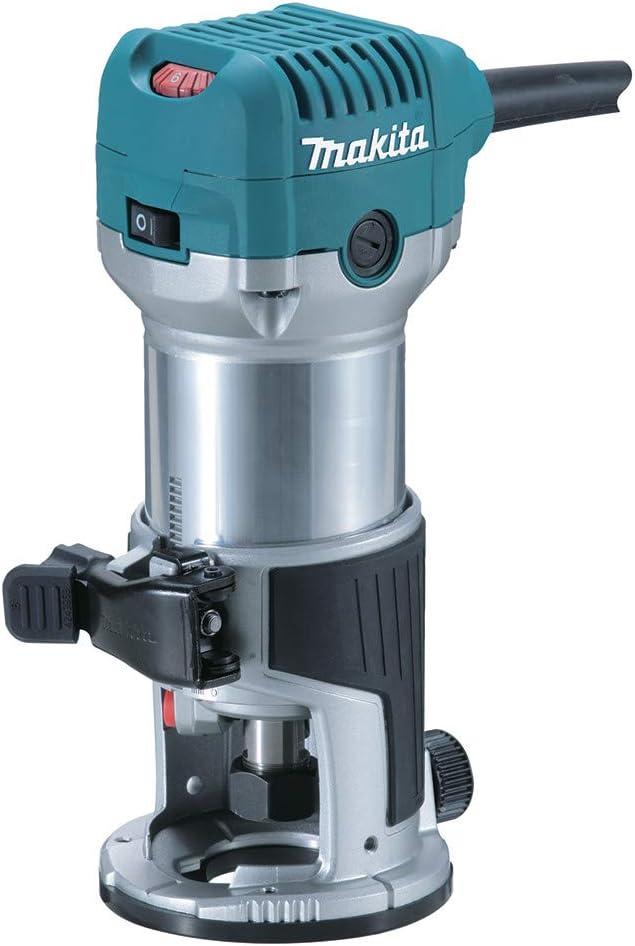
 Best For: Most users, higher speed, lighter, includes edge guide
 Price: $149

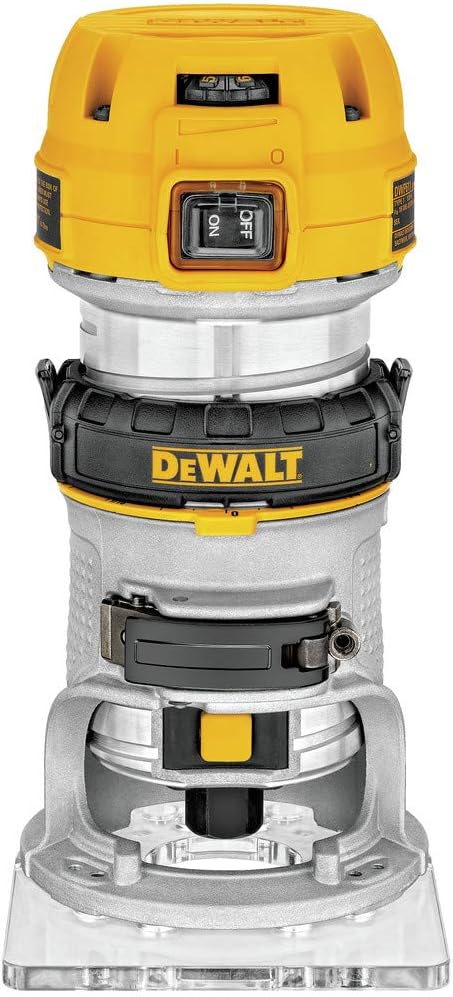
- Best For: Work in dim areas, want LED illumination
- Price: $167
Introduction
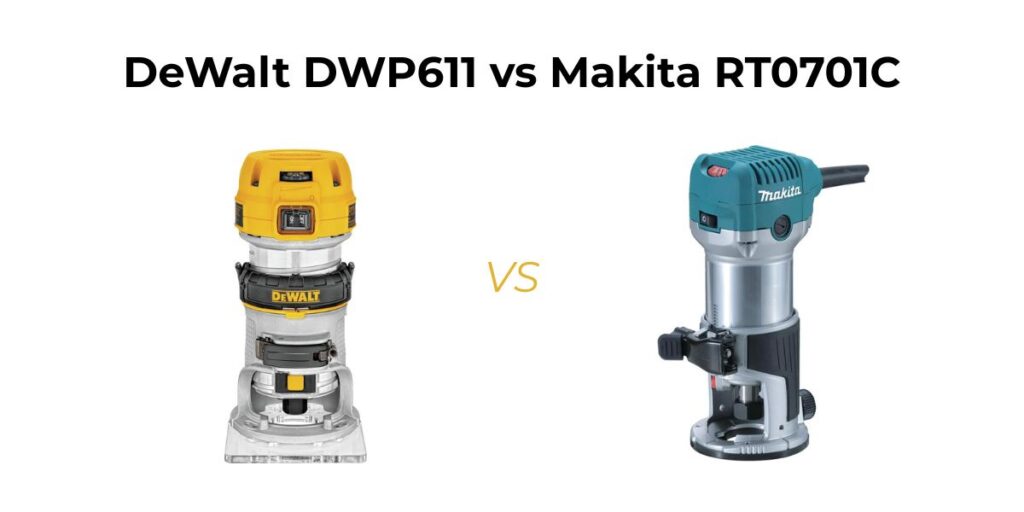
Are you struggling to choose between DeWalt DWP611 vs Makita RT0701C? Both routers are popular, powerful, and trusted by woodworkers, but each one shines in a different way.
In this quick guide, I’ll break down the real differences—so you can skip the confusion and pick the router that actually fits your work style and projects.
Table of Contents
Quick Verdict:
The Makita RT0701C wins at $149 with higher max speed (30,000 RPM vs 27,000), lighter weight (3.9 vs 4.1 lbs), and includes a straight edge guide. The DeWalt DWP611 costs $167 but adds dual LED work lights and electronic speed control—worth considering for dimly-lit work.
The Real Difference: Speed Range vs LED Lights
| Features | RT0701C 🏆 | DWP611 |
|---|---|---|
| Price | $149 | $167 |
| Speed Range | 10,000-30,000 RPM ✓ | 16,000-27,000 RPM |
| Max Speed | 30,000 RPM ✓ | 27,000 RPM |
| Min Speed | 10,000 RPM ✓ | 16,000 RPM |
| Motor Power | 1.25 HP (6.5 amps) | 1.25 HP (7 amps) ✓ |
| Weight | 3.9 lbs ✓ | 4.1 lbs |
| LED Work Lights | No | Yes (dual LEDs) ✓ |
| Edge Guide | Included ✓ | Sold separately ($15) |
| Base Shape | Round | Square ✓ |
| Soft Start | Yes ✓ | Yes ✓ |
| Overall rating | ⭐⭐⭐⭐⭐(4.8/5) | ⭐⭐⭐⭐(4.7/5) |
| Where To Buy | Check On Amazon | Check On Amazon |
Both corded routers deliver 1.25 HP power, variable speed control, soft-start motors, and accept 1/4″ collet bits. The Makita offers wider speed range and costs less. The DeWalt adds LED lights and electronic speed feedback but costs $18 more.
Related Articles:
Why Makita RT0701C Is the Better Buy?
The Makita RT0701C delivers better value at $18 less than the DeWalt with superior speed range and lighter weight.
1. Wider Speed Range (10,000-30,000 RPM)
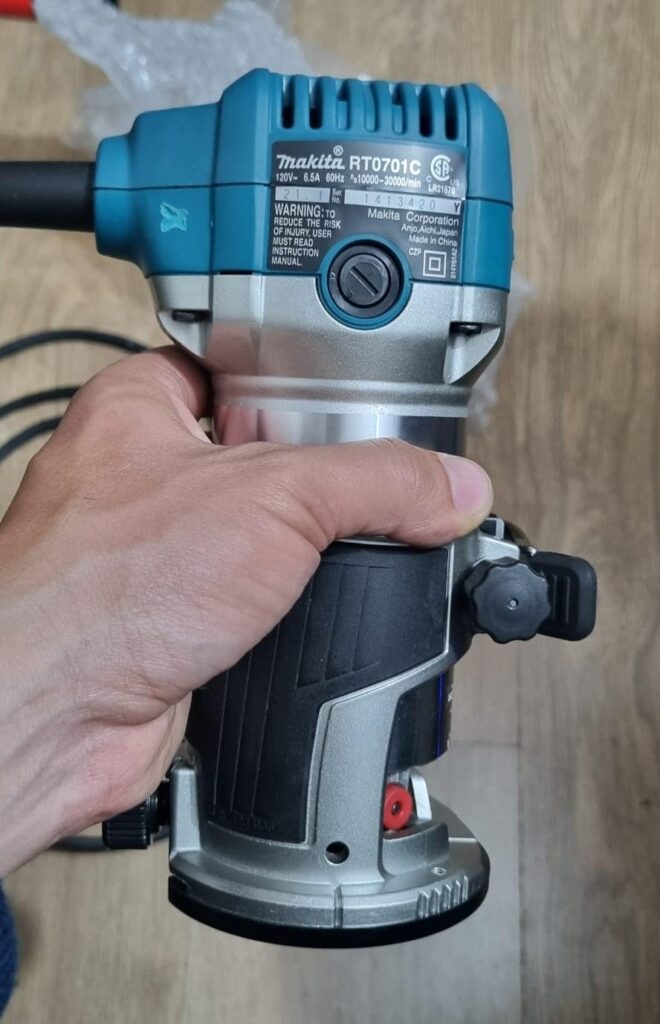
The Makita’s speed range spans 10,000-30,000 RPM compared to DeWalt’s 16,000-27,000 RPM. This means:
- Higher max speed: 30,000 RPM vs 27,000 (11% faster for smooth cuts)
- Lower min speed: 10,000 RPM vs 16,000 (better control for delicate work)
- Wider range: 20,000 RPM span vs 11,000 (more versatility)
According to woodworkers on Sawmill Creek forums, the Makita’s higher top speed produces cleaner edge profiles and smoother dados in hardwood. The lower minimum speed provides better control when routing soft plastics or delicate veneers.
2. $18 Less + Includes Edge Guide
At $149, the Makita costs $18 less than the DeWalt’s $167. Plus it includes:
- Straight edge guide (DeWalt’s costs $15 separately)
- Standard fixed base
- Wrench
Total value difference: ~$33 in Makita’s favor.
- Best For: Most users, higher speed, lighter, includes edge guide
- Price: $149
3. Lighter Weight (3.9 vs 4.1 lbs)
The Makita weighs 3.9 lbs compared to DeWalt’s 4.1 lbs. While 0.2 lbs seems minor, according to user reviews on Amazon and woodworking forums, this difference becomes noticeable during:
- Extended edge routing sessions
- Overhead trim work
- Fine detail routing requiring steady control
One verified Amazon reviewer states: “The Makita feels noticeably lighter in hand. After routing 40 feet of table edge, my arms weren’t as tired.”
4. Popular in CNC Community

The Makita RT0701C is the preferred router for DIY CNC machines (Shapeoko, X-Carve, Onefinity) due to:
- Precise speed control
- Smooth operation
- Compact 65mm diameter body (fits standard CNC mounts)
- Proven reliability for extended runtime
While this doesn’t affect handheld woodworking, it demonstrates the tool’s precision and quality.
Real User Feedback
Based on Amazon review analysis:
- Makita RT0701C: 4.8/5 stars from 4,900+ verified buyers
- DeWalt DWP611: 4.7/5 stars from 7,800+ verified buyers
Common praise for RT0701C: “smoother than DeWalt,” “love the higher RPM,” “lighter and easier to control,” “great value with included edge guide”
Common praise for DWP611: “LED lights are game-changer,” “variable speed dial is convenient,” “soft start works perfectly,” “electronic feedback maintains speed under load”
When DeWalt DWP611 Makes Sense?
The DeWalt costs $18 more but delivers features some users specifically want.
Choose DWP611 if:
- Best For: Work in dim areas, want LED illumination
- Price: $167
- You work in basements, closets, or dimly-lit areas (LED lights matter)
- You want electronic speed feedback that maintains RPM under load
- You prefer square base for edge routing (sits flatter against straight edges)
- You value DeWalt’s widespread parts availability and service network
- You like the clear sub-base design (better visibility even without LEDs)
At $167, the dual LED work lights illuminate the cutting area significantly. According to Tool Craze’s review, “The LEDs make a huge difference when routing dados in cabinet interiors or working in basement workshops.”
The LED advantage: Multiple woodworking forum users specifically cite the DeWalt’s LED lights as their primary reason for choosing it over the Makita. If you frequently work in areas with poor lighting, the LEDs justify the $18 premium.
Quick Buying Decision: 2 Questions
1. Do you work in dimly-lit areas?
- Yes, LEDs matter → DWP611 (dual LED illumination worth $18 premium)
- No, good lighting available → RT0701C (save $18, better speed range)
2. Do you need higher speed capability?
- Yes, for smooth hardwood routing → RT0701C (30,000 RPM max)
- No, 27,000 RPM is plenty → Either works (but RT0701C still costs less)
Quick answer:
- Best value for most users: [GET RT0701C – SAVE $18, higher speeds →]
- Best for dim work areas: [GET DWP611 – Dual LED lights →]
Detailed Specs Comparison
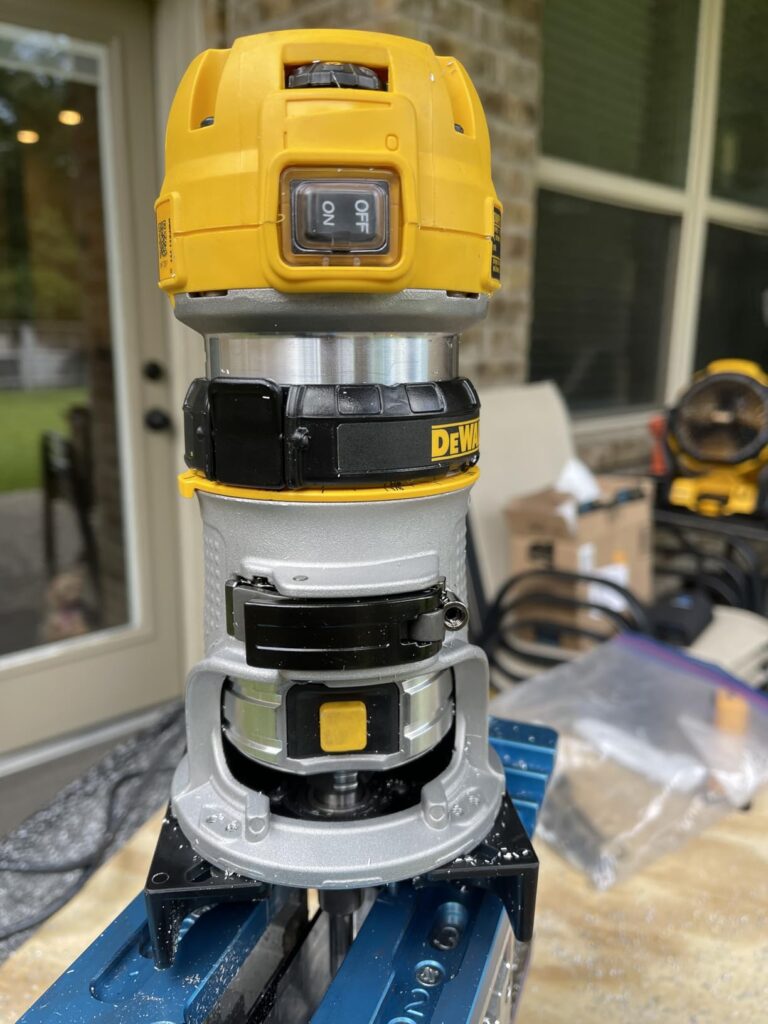
Motor & Power:
- Makita RT0701C: 1.25 HP, 6.5 amps, 10,000-30,000 RPM
- DeWalt DWP611: 1.25 HP, 7 amps, 16,000-27,000 RPM
- Both: Soft-start motor technology
- Both: Variable speed control via dial
Speed Control:
- Makita: 6-position variable speed dial
- DeWalt: Variable speed dial with electronic feedback (maintains speed under load)
- Makita: Wider speed range (20,000 RPM span)
- DeWalt: Electronic speed control more precise
Physical Specs:
- Makita: 3.9 lbs, round base, 65mm diameter body
- DeWalt: 4.1 lbs, square base (4″ dimension)
- Makita: Slightly more compact overall
- DeWalt: Square base better for edge work
Features:
- Makita: Soft start, rubber overmolded body, tilt base
- DeWalt: Dual LEDs, clear sub-base, 12-position spindle lock
- Makita: Includes straight edge guide
- DeWalt: Depth adjustment within 1/64″
Included Accessories:
- Makita: Fixed base, edge guide, 1/4″ collet, wrench
- DeWalt: Fixed base, wrench (edge guide sold separately)
Collet Capacity:
- Both: 1/4″ collet standard
- Makita: Compatible with 3/8″ and 1/2″ collets (sold separately)
- DeWalt: 1/4″ only
Plunge Depth:
- Makita: 1-9/16″ plunge capacity (with optional plunge base)
- DeWalt: 1-1/2″ plunge capacity (with optional plunge base)
- Both: Plunge bases sold separately or in kit versions
Warranty:
- Both: 3-year limited warranty
- Both: 1-year free service contract
- Both: 90-day money-back guarantee
Best Use Cases
Makita RT0701C Excels At:
- Edge profiling and round-overs
- Dado cuts and grooves
- Template routing with Makita guides
- Hardwood routing (higher max speed)
- All-day routing (lighter weight)
- CNC mounting (if you ever go that route)
- Budget-conscious professionals
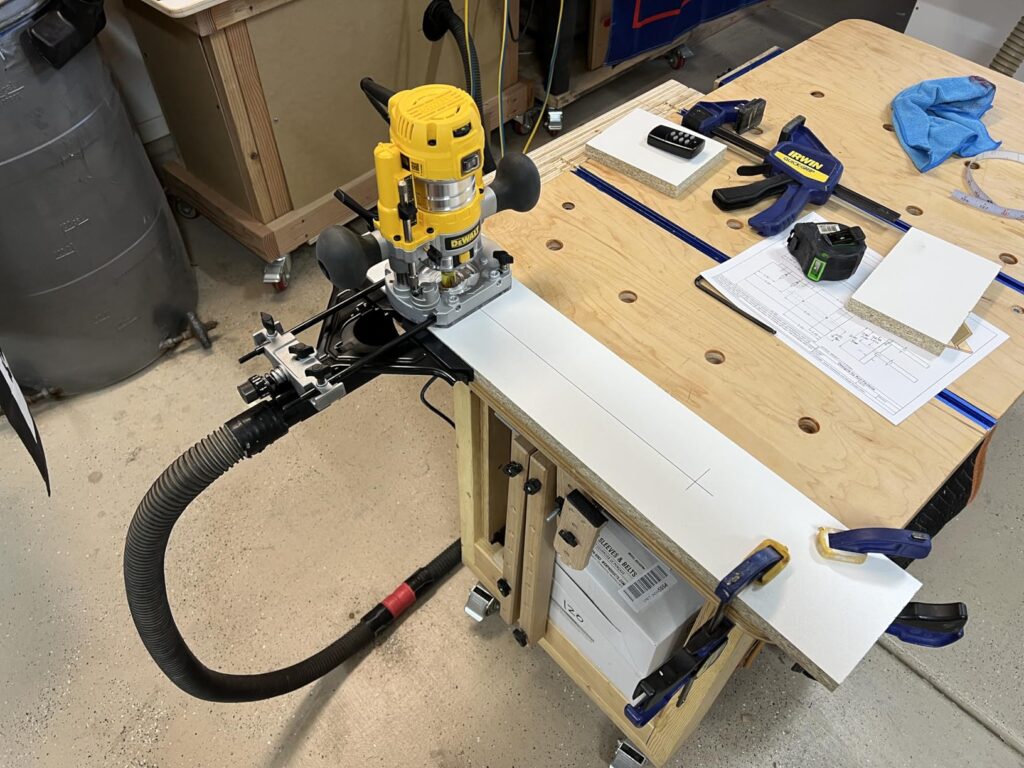
DeWalt DWP611 Excels At:
- Routing in dim lighting (basements, closets)
- Cabinet interior work (LEDs illuminate work)
- Edge routing (square base sits flat)
- Users preferring DeWalt ecosystem
- Routing where load varies (electronic speed control)
- Clear visibility needs (clear sub-base + LEDs)
Both Handle Equally:
- Round-overs and edge profiles
- Mortising and dado cuts
- Decorative inlays
- Sign making
- Trim work
- Furniture edge detailing
- General woodworking projects
Kit Options Available
Makita Kits:
- RT0701C: Fixed base only, $149
- RT0701CX7: Includes plunge base, tilt base, offset base, edge guide, $199
- RT0701CX4: Compact kit with plunge base, $179
DeWalt Kits:
- DWP611: Fixed base only, $167
- DWP611PK: Includes plunge base, $199
If you plan to use a plunge base, the kit versions save $20-30 compared to buying bases separately. The Makita CX7 kit includes more base options than DeWalt’s PK kit.
The LED Lights Question: Are They Essential?
The DeWalt’s dual LED lights are its primary advantage over the Makita. Here’s the honest assessment:
LEDs are valuable if you:
- Route in basement workshops
- Work inside cabinets or closets
- Do trim work in existing homes (often dim)
- Route dados in cabinet interiors
- Work early mornings or evenings
LEDs are nice-to-have if you:
- Have well-lit workshop
- Route primarily on workbench with overhead lights
- Work outdoors during daytime
- Use auxiliary work lights already
According to woodworking forum discussions, users split roughly 60/40 on LED importance:
- 60% say “nice but not essential with good workshop lighting”
- 40% say “absolutely worth it, use them constantly”
If you’re unsure, the Makita at $149 is the safer bet. You can always add clip-on LED work lights later for $10-15 if needed.
Bottom Line: Save $18 and Get Higher Speeds
- Best For: Most users, higher speed, lighter, includes edge guide
- Price: $149
For most users: The Makita RT0701C at $149 delivers higher maximum speed (30,000 RPM), lighter weight (3.9 lbs), wider speed range, and includes an edge guide. Save $18 versus the DeWalt and get superior speed capability for hardwood routing.
For dim workspace users: The DeWalt DWP611 at $167 adds dual LED work lights and electronic speed control. If you frequently route in basements, closets, or poorly-lit areas, the LEDs justify the $18 premium.
Honest recommendation: Unless you specifically need LED illumination, buy the Makita RT0701C. It costs less, runs faster (30K vs 27K RPM), weighs less, and includes the edge guide. You can always add clip-on LED work lights for $10 if you ever need them.
FAQs
Which router is quieter?
According to user reviews, the Makita runs slightly quieter at lower speeds, but both are reasonably quiet for compact routers. Neither is whisper-quiet, but both are noticeably quieter than full-size 2+ HP routers.
Are the LED lights on the DeWalt really worth $18?
Depends on your workspace. If you frequently route in basements, closets, inside cabinets, or under poor lighting, multiple users report the LEDs are “absolutely worth it.” For well-lit workshops, the LEDs are a nice-to-have, not essential.
Which one handles hardwood better?
The Makita’s higher 30,000 RPM max speed produces cleaner cuts in hardwood according to woodworking forum discussions. The faster bit speed reduces tear-out and produces smoother profiles in oak, maple, and walnut.
Can I use Porter-Cable template guides on both?
The DeWalt accepts Porter-Cable style template guides directly. The Makita requires an adapter (sold separately, ~$15) to use Porter-Cable guides, but includes compatibility with Makita’s own template system.
Which one is better for CNC use?
The Makita RT0701C is overwhelmingly preferred in the DIY CNC community (Shapeoko, X-Carve, Onefinity). Its 65mm diameter fits standard CNC mounts, and the smoother operation produces better results during long automated cuts.
Is the DeWalt’s electronic speed control important?
For handheld woodworking, it’s a nice feature but not critical. The electronic feedback maintains consistent RPM when bit loads vary, providing slightly more consistent cuts. Most users won’t notice a significant difference versus the Makita’s mechanical speed control.