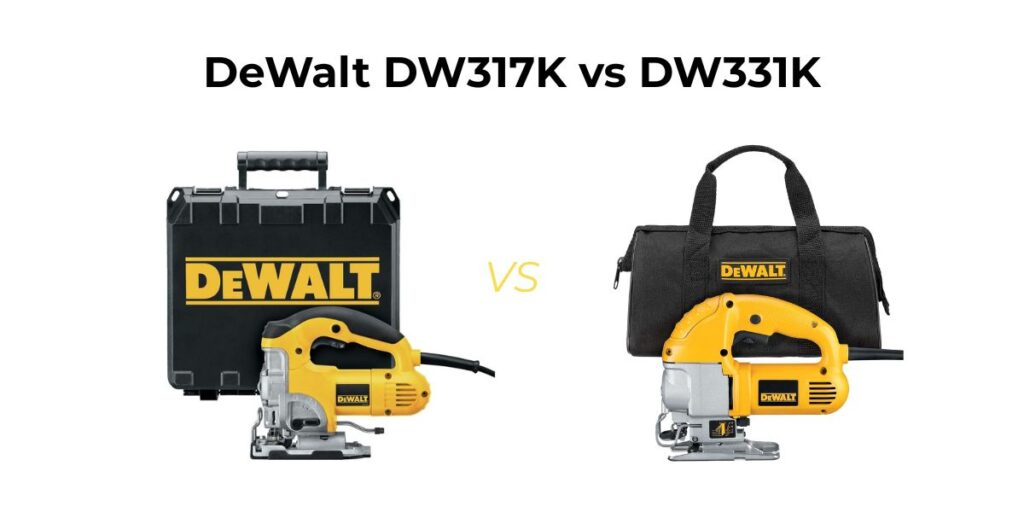
Current Price: $129
- Get this if: You're cutting standard lumber, plywood, and softwoods for home projects. The 5.5A motor handles everything most DIYers need, and you can spend the savings on quality blades.
- Includes: Case, anti-splinter insert, 1 blade
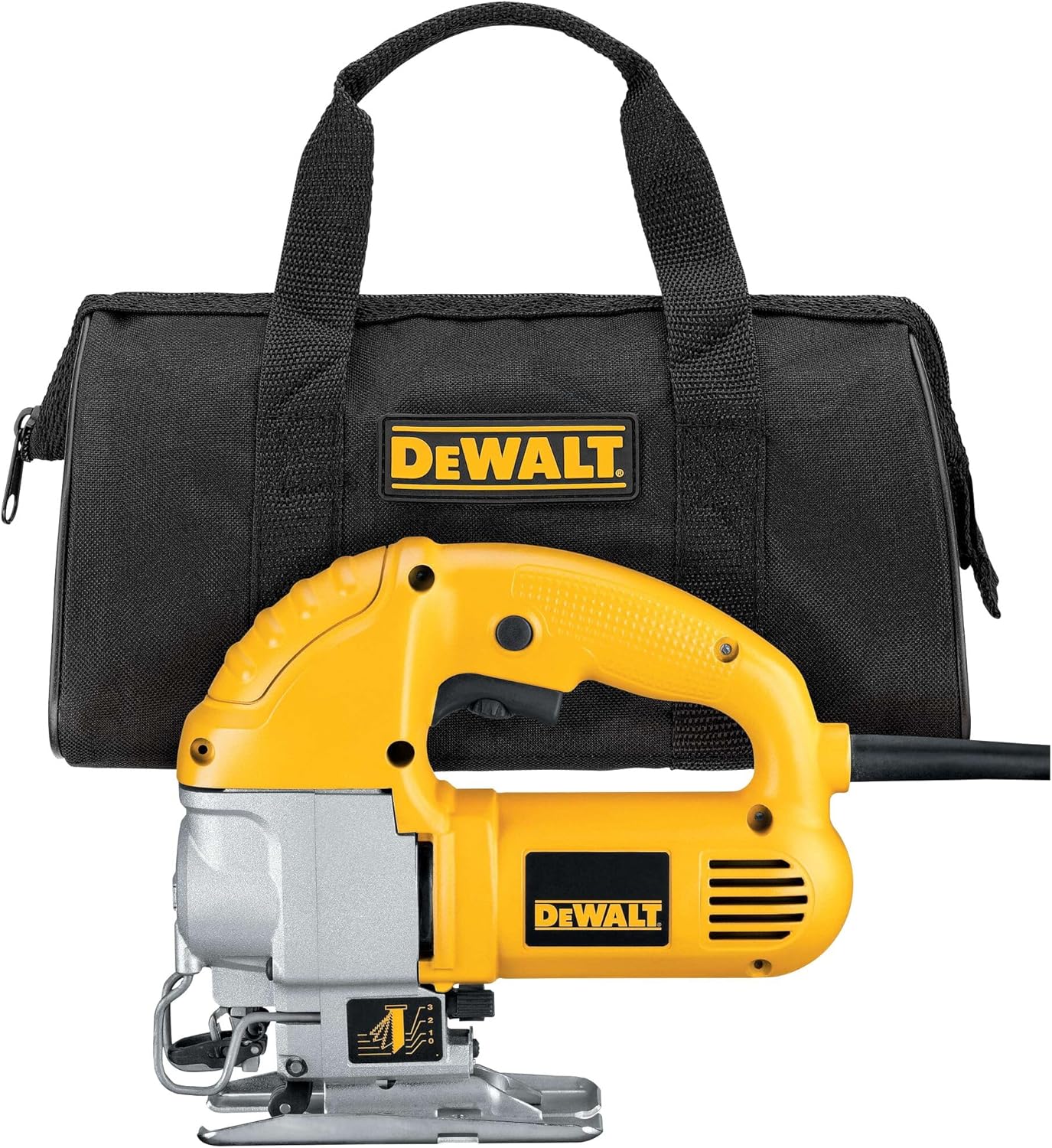

Current Price: $151
- Get this if: You work with hardwoods, need variable speed for detail cuts, or use your jigsaw regularly. The extra power and speed control justify the $22 premium for serious users.
- Includes: Hard case, anti-splinter insert, dust blower, 1 blade
Introduction
Nobody can figure out if the DW331K is worth $22 more than the DW317K.
Not $5 more. Not $10 more. Twenty-two dollars.
That’s the perfect amount to drive you crazy. It’s enough money that you don’t want to waste it, but not so much that the answer is obvious.
You’re standing in the tool aisle (or staring at your screen) asking yourself: “What am I actually getting for that extra $22?”
In this DeWalt DW317K vs DW331K guide, I’m going to answer that question.
Table of Contents
At-a-glance: DeWalt DW317K vs DW331K
| Features | DW317K | DW331K |
|---|---|---|
| Price | $129 | $151 |
| Motor Power | 5.5 Amp | 6.5 Amp |
| Speed Control | Single speed (3,100 SPM) | Variable (500-3,100 SPM) |
| Best For | Basic DIY, softwoods | Hardwoods, detail work |
| Vibration Control | Standard | Counterbalanced |
| Dust Blower | No | Yes (mediocre) |
| Weight | 6.2 lbs | 6.4 lbs |
| Bevel Detents | 2 positions | 4 positions |
| Cord Length | 7 feet | 7 feet |
| Warranty | 3-year limited | 3-year limited |
| Where To Buy | Check On Amazon | Check On Amazon |
TL;DR:
The DW331K costs $22 more and adds four things: a more powerful motor (6.5A vs 5.5A), variable speed control, better vibration dampening, and a dust blower that barely works. If you’re cutting thick hardwood or doing detail work where you need to slow down, get the DW331K. If you’re doing basic DIY cuts in plywood and 2x4s, the DW317K does the exact same job and you can spend that $22 on better blades instead.
Related Articles:
The Problem Both Saws Share (And Nobody Talks About)
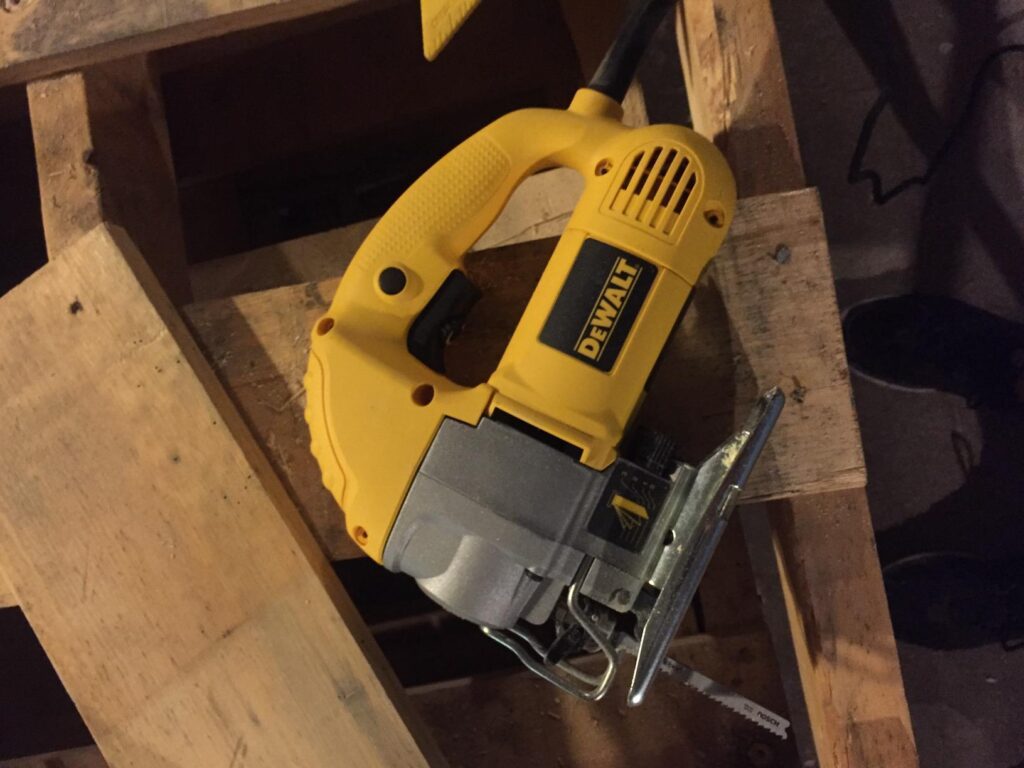
Before we get into what separates these two jigsaws, let’s talk about what they have in common—because there’s one issue that affects both models, and it’s the kind of thing that makes you wonder if anyone at DeWalt actually uses these saws.
The blade wanders.
Not a little bit. Not “only if you’re doing something wrong.” It wanders enough that multiple users mention it specifically. One contractor on Garage Journal put it perfectly: “The blade shifts inside the clamp and gets jammed that way, causing the jigsaw to pull to one side.”
Here’s what this means in real life: When you’re cutting curves—especially in thicker material—the blade doesn’t track where you’re pointing the saw. It drifts. You start your cut aiming for your pencil line, and by the time you’re halfway through, you’re a quarter-inch off course.
Is this a deal-breaker? Depends on what you’re cutting. If you’re notching 2x4s for framing or making rough cuts that’ll get covered up, you won’t care. But if you’re cutting laminate countertops or doing any finish work where accuracy matters, you need to know this going in.
The DW331K handles this slightly better because of its counterbalance mechanism, but don’t expect miracles. Both saws have the same fundamental blade clamp design, and that’s where the problem lives.
What That Extra $22 Actually Buys You?
Let’s break down the four differences between these saws and whether each one matters:
1. Motor Power: 5.5A vs 6.5A
The DW331K has a more powerful motor. On paper, that’s a 20% increase in amperage.
In practice? You’ll notice this in exactly two scenarios:
Scenario A: You’re cutting hardwood thicker than 1 inch. The DW317K will do it, but it’ll slow down and labor through the cut. The DW331K powers through without bogging down.
Scenario B: You’re making long cuts and the saw starts heating up. The bigger motor on the DW331K runs cooler under sustained use.
If you’re mostly cutting pine, plywood, or pressure-treated lumber for deck projects, you will never feel the difference. The 5.5A motor handles those materials without breaking a sweat.
Real-world verdict: Worth $10 of that $22 if you work with hardwoods regularly. Worth $0 if you don’t.
2. Variable Speed Control: The Feature That Actually Matters
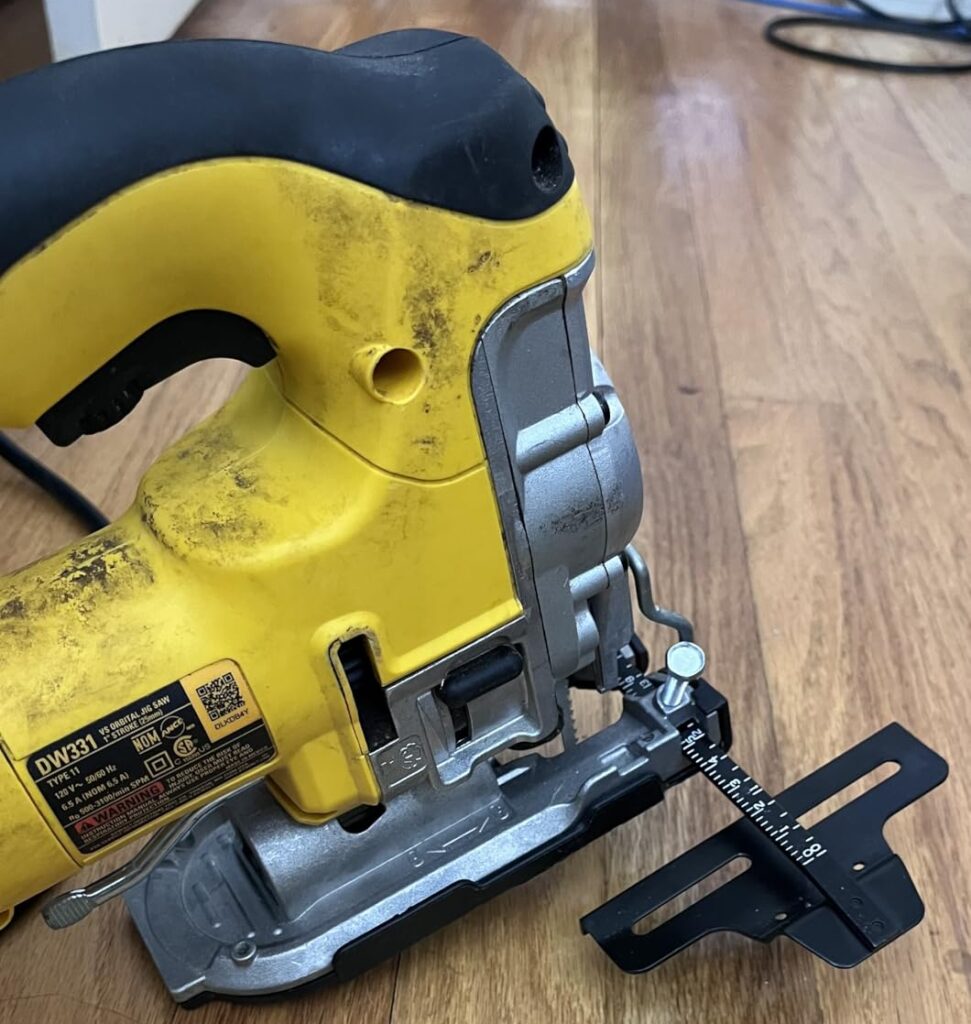
This is the difference that changes how you use the saw.
The DW317K has one speed: fast (3,100 strokes per minute). Every time you pull the trigger, you’re at full speed.
The DW331K has variable speed (500-3,100 SPM). You can dial it down for delicate work and ramp it up for aggressive cuts.
Why does this matter?
Let’s say you’re cutting a sink hole in a laminate countertop. With the DW317K, you’re blasting away at 3,100 strokes per minute, trying to follow your line precisely while the saw is vibrating like crazy. With the DW331K, you can slow it down to 1,500 SPM, take your time, and actually control where the blade goes.
Or maybe you’re cutting PVC pipe. At full speed, plastic tends to melt and grab the blade. Slow speed solves that.
Real-world verdict: This is worth the other $12 if you do any detail work, cut plastics, or need control for precision. If you’re just ripping boards and making rough cuts, you don’t need it.
3. The Dust Blower That Doesn’t Really Work
DeWalt markets this as a premium feature on the DW331K. Here’s what they don’t tell you: it barely moves enough air to matter.
Users still have to manually blow dust off their cut line.
Does it help a little? Sure. Is it worth buying the DW331K specifically for this feature? Absolutely not.
If you want actual dust control, buy a shop vac with a hose attachment. The built-in blower is the kind of feature that sounds great in marketing copy and disappoints in your garage.
Real-world verdict: Worth maybe $0.50 of emotional value. Don’t factor this into your decision.
4. Counterbalance Mechanism: Less Vibration
The DW331K has a counterbalance system that reduces vibration. You can actually feel the difference if you’re using both saws back-to-back.
Here’s where it matters: If you’re making long cuts or using the saw for extended periods, less vibration means less hand fatigue. It also means slightly more control, which ties back into that blade wander problem I mentioned earlier.
Here’s where it doesn’t matter: For quick, occasional cuts, you’re not holding the saw long enough for vibration to become an issue.
Real-world verdict: Worth about $5 if you use your jigsaw frequently. Worth nothing if you pull it out twice a year.
The Short Cord Problem (Both Models)
While we’re talking about disappointing realities, let’s address the elephant in the room: both saws come with a 7-foot power cord.
Seven. Feet.
Most corded tools have 10-12 foot cords. DeWalt decided to cheap out here, and it affects both models equally. Unless you work within arm’s reach of an outlet, you’re buying an extension cord with this saw. Factor that into your budget.
Why am I mentioning this? Because you’re going to discover this limitation about 30 seconds into your first project.
When The DW317K Is The Right Choice?
Current Price: $129
- Get this if: You're cutting standard lumber, plywood, and softwoods for home projects. The 5.5A motor handles everything most DIYers need, and you can spend the savings on quality blades.
- Includes: Case, anti-splinter insert, 1 blade
You should buy the cheaper DW317K if:
- You’re cutting standard construction materials: Plywood, 2x4s, OSB, pressure-treated lumber. The 5.5A motor handles all of this without complaint.
- You don’t need precision curves: You’re making utility cuts for rough carpentry, not finish work.
- You use a jigsaw occasionally: It’s a tool you need in your collection but don’t reach for every week.
- You’d rather spend money on better blades: Here’s a pro tip—the blade matters more than the saw for most cuts. That $22 difference buys you a good assortment of T-shank blades that’ll transform how either saw performs.
Real project examples where the DW317K shines:
- Cutting deck boards to length
- Notching studs for electrical boxes
- Trimming door jambs for flooring installation
- Basic craft projects in 1/2″ or 3/4″ material
When The DW331K Is Worth The Extra $22
Current Price: $151
- Get this if: You work with hardwoods, need variable speed for detail cuts, or use your jigsaw regularly. The extra power and speed control justify the $22 premium for serious users.
- Includes: Hard case, anti-splinter insert, dust blower, 1 blade
You should spend the extra money on the DW331K if:
- You work with hardwoods regularly: Oak, maple, walnut—materials where that extra motor power actually shows up.
- You need variable speed for detail work: Cutting tight curves in countertops, working with plastics, or any scenario where you need to slow down and maintain control.
- You use your jigsaw for hours at a time: The counterbalance mechanism makes a real difference during extended use.
- You’re doing finish carpentry: When accuracy matters and you need every advantage you can get to fight that blade wander issue.
Real project examples where the DW331K justifies itself:
- Installing laminate or solid-surface countertops
- Cutting complex curves for custom woodworking
- Any production work where you’re making 20+ cuts in a session
- Cutting plastics, composites, or materials that need speed control
The Bevel Situation (Spoiler: It’s Complicated)
Here’s something that doesn’t make sense: The DW331K has four bevel detents (0°, 15°, 30°, 45°) while the DW317K only has two (0°, 45°). More detents should be better, right?
Except multiple DW331K owners report that the bevel lock slips under pressure.
So, you’ve got more bevel positions, but less confidence that they’ll stay locked when you’re actually cutting. The irony is painful.
Both saws have this issue to some degree, but it seems more common on the DW331K. The fix is simple but annoying: tighten the bevel lock knob more than you think you need to, and double-check it before starting your cut.
What About The Accessories?
Both saws come with the same basic kit:
- Hard carrying case (actually pretty decent)
- One T-shank blade (throw it away, it’s garbage)
- Anti-splinter insert (this actually helps)
- Hex wrench (for blade changes)
Neither saw includes the accessories that would actually be useful:
- Quality blade assortment
- Edge guide
- Circle cutting attachment
Budget for at least another $20-30 in blades regardless of which saw you buy. The stock blade is the bare minimum for demonstration purposes.
The Verdict: Decision Tree
Stop thinking “which saw is better” and start thinking “which saw fits my situation.”
Choose the DW317K ($129) if:
- ↳ You’re cutting mostly softwood and sheet goods
- ↳ AND you don’t need variable speed
- ↳ AND you use a jigsaw occasionally (less than once a month)
- ↳ Result: Save the $22 and buy better blades
- ↳ AND you use a jigsaw occasionally (less than once a month)
- ↳ AND you don’t need variable speed
Choose the DW331K ($151) if:
- ↳ You cut hardwoods regularly
- ↳ OR you need variable speed for detail work
- ↳ OR you use your jigsaw multiple times per week
- ↳ Result: The extra features justify the cost
- ↳ OR you use your jigsaw multiple times per week
- ↳ OR you need variable speed for detail work
Choose NEITHER if:
- ↳ You need precision cutting for professional finish work
- ↳ AND blade wander will cost you time/money
- ↳ Result: Spend $180 on a Bosch 1590EVSK instead
- ↳ AND blade wander will cost you time/money
Choose NEITHER if:
- ↳ You already own a cordless drill/driver system
- ↳ AND you value mobility over power
- ↳ Result: Get DeWalt’s cordless DCS334B (if you have 20V batteries)
- ↳ AND you value mobility over power
The Hidden Third Option
To be very honest, if you’re serious about jigsaw work and need precision, neither of these saws is really the right answer.
The blade wander issue I mentioned at the start? It’s not something you can fix with technique or better blades. It’s baked into the design of these saws. They’re workhorses for construction and DIY, but they’re not precision instruments.
If you’re cutting countertops for a living, doing fine woodworking, or making anything where a 1/8-inch deviation matters, you should be looking at the Bosch 1590EVSK (~$180) or spending even more for a Festool. Those saws have better blade guidance systems that actually keep the blade tracking straight.
But for most people reading this article? You’re probably overthinking it. Both the DW317K and DW331K will handle 90% of what homeowners and casual woodworkers need from a jigsaw.
What I’d Buy? (And Why)
If someone put a gun to my head and made me choose between these two saws, I’d buy the DW317K.
Here’s my reasoning: The $22 difference is real money, and I can get better results by putting that money toward a proper blade assortment than by getting variable speed I’d use maybe 10% of the time.
The situations where the DW331K’s extra power actually matters—cutting thick hardwoods or doing production work—are also the situations where blade wander becomes a deal-breaker. And if I’m already compromising on precision because of blade wander, why pay extra for features that give me marginal improvements?
I’d rather have the cheaper saw plus $22 worth of quality Bosch or DeWalt T-shank blades. A proper blade designed for clean cuts in your specific material will do more for your results than variable speed or counterbalance.
That said, if you know you need variable speed because you work with plastics or do a lot of detail curves, then get the DW331K. That feature alone is worth the upcharge for the right user.
FAQs
Q: Can the DW317K cut 2x4s and deck boards?
Yes, easily. The 5.5A motor handles standard construction lumber without any issues. You only need the DW331K’s extra power if you’re cutting hardwoods or materials thicker than 2 inches regularly.
Q: Does the dust blower on the DW331K actually work?
It exists, but don’t expect miracles. Multiple users report it moves some dust but isn’t effective enough to eliminate manual blowing. Don’t buy the DW331K specifically for this feature.
Q: Which saw is better for cutting countertops?
The DW331K, but neither is ideal. Variable speed helps with laminate cutting, but both saws have blade wander issues on precision cuts. For professional countertop work, consider the Bosch 1590EVSK instead.
Q: Can I use the same blades in both saws?
Yes, both use standard T-shank blades. Any T-shank blade from Bosch, DeWalt, or other brands will fit both models. Avoid U-shank blades—they won’t work.
Q: Is the DW331K worth it if I only use a jigsaw a few times a year?
Probably not. If you’re an occasional user cutting standard materials, the DW317K does the same job for $22 less. Put that money toward better blades or save it for your next tool purchase.
Q: Do these saws work with DeWalt’s cordless batteries?
No, both are corded-only models. If you want cordless, look at DeWalt’s 20V MAX DCS334B, which uses the same battery system as their drill/driver lineup.