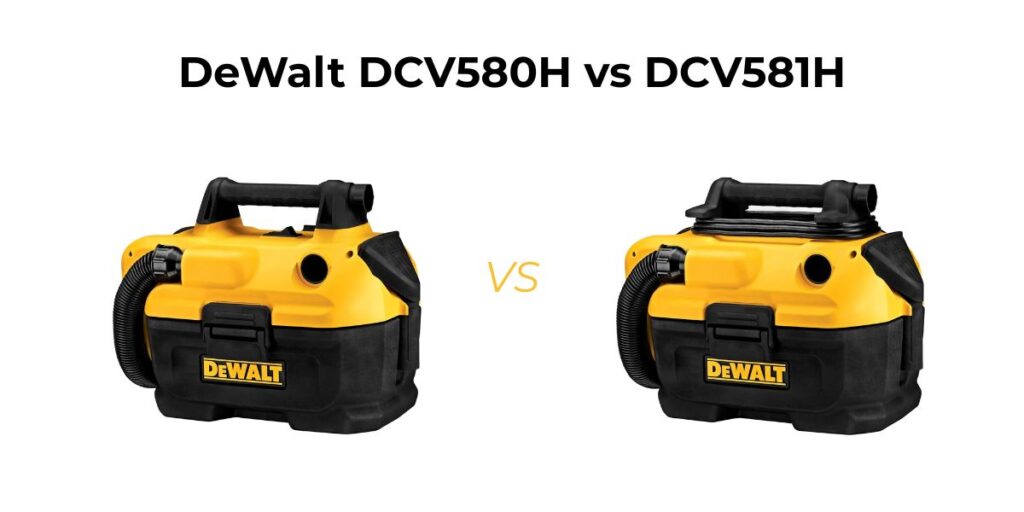
Current Price: $199
🏆Why buy it:
- HEPA filtration for fine dust and allergies
- Can run plugged in when batteries die
- Better choice for professionals and indoor work
✅Best for: Contractors, allergy-sensitive users
⚠Watch out: Heavier and costs more
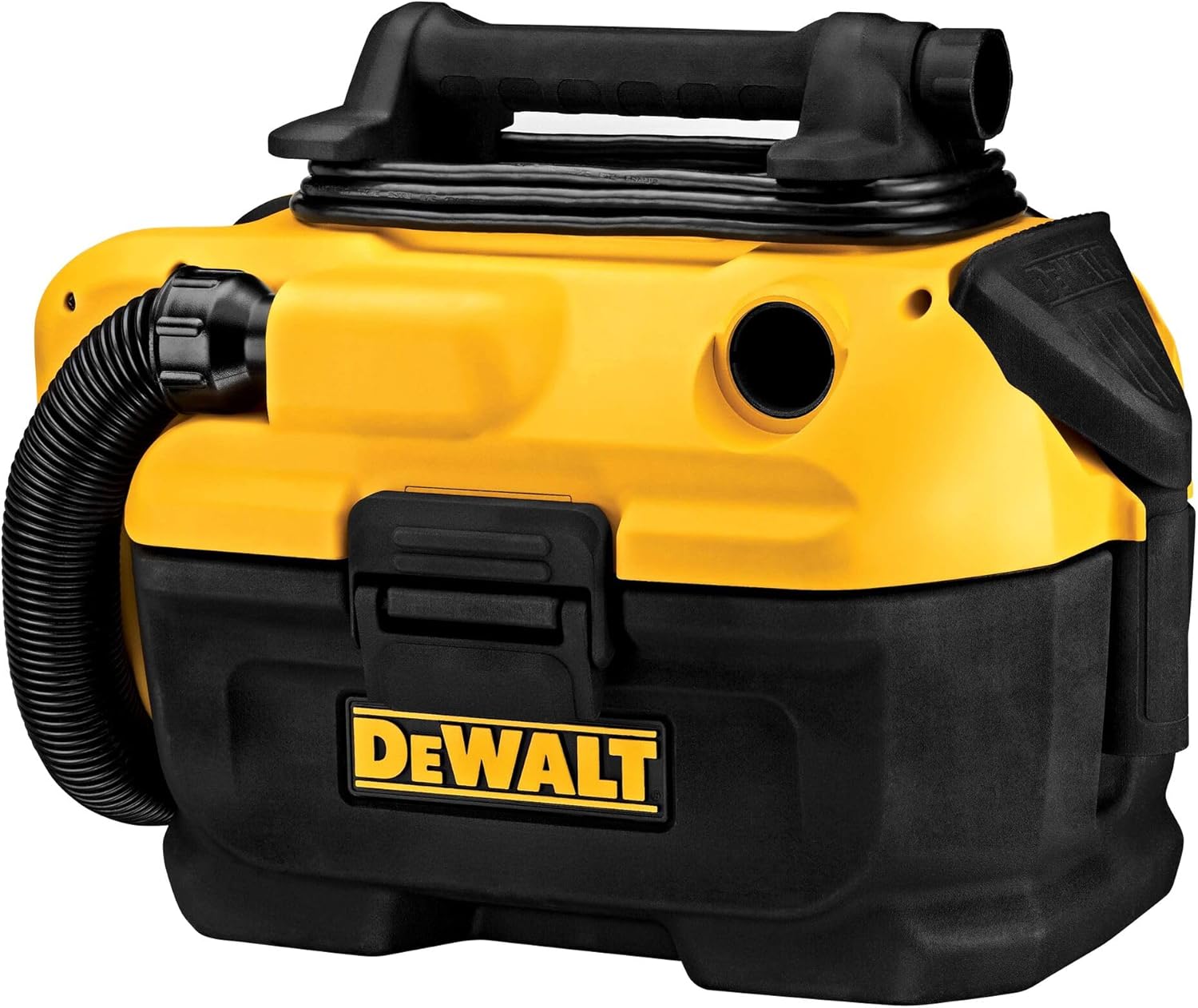

Current Price: $158
🏆Why buy it:
- Lightweight and easy to carry
- Perfect if you already own DeWalt 20V batteries
- Ideal for cars, workbenches, and quick cleanups
✅Best for: DIYers, mechanics, mobile detailing
⚠Watch out: No HEPA filter, battery-only operation
Introduction
Let me tell you about the most frustrating design flaw I’ve discovered in these DeWalt cordless vacuums—one that literally no one talks about, but nearly every actual user complains about once they start using it.
You’re crouched down cleaning out your car or vacuuming sawdust from your workbench. The vacuum is running great, sucking up debris… and simultaneously blowing all that debris right back at you from the exhaust port. You’re essentially playing a game of “one step forward, two steps back” with your own vacuum.
This isn’t just annoying—it’s a fundamental design oversight that turns what should be a quick cleanup into a frustrating experience. And it’s just one of several surprises waiting for anyone comparing DeWalt DCV580H vs DCV581H.
Table of Contents
TL;DR:
The DCV580H ($158) is battery-only and lighter, while the DCV581H ($199) adds AC power and HEPA filtration for $41 more. But here’s what matters: both share the same problematic exhaust port design, both deliver only 10 CFM (despite claiming 31), and the “hybrid” model weighs 13% more without offering proportionally better performance. Your decision hinges on whether you need AC backup power and HEPA filtration—not which one performs better, because they’re nearly identical in real-world suction.
Related Articles:
At-a-glance: DeWalt DCV580H vs DCV581H
| Features | DCV580H | DCV581H |
|---|---|---|
| Power Source | Battery only | Battery + 120V AC |
| Filter Type | Standard washable | HEPA (99.97%) |
| Weight (real-world) | ~8.0 lbs | ~9.1 lbs |
| Airflow (real use) | ~10 CFM | ~10 CFM |
| Best For | Portability, existing batteries | Allergies, long sessions |
| Current Price | $158 | $199 |
| Where To Buy | Check On Amazon | Check On Amazon |
DCV580H costs $158 and DCV581H costs $199.
That $41 gap completely changes the value equation. When these were priced within $10 of each other, the DCV581H was an obvious choice—you got AC power and HEPA filtration for basically free. At a $41 premium? Now we need to actually justify that cost.
And here’s the other thing no one will tell you: independent testing from Tech Gear Lab found these vacuums deliver only 10 CFM of airflow, not the 31 CFM that DeWalt claims. For context, a decent shop vac delivers 200+ CFM. So if you’re expecting shop-vac performance in a cordless package, we need to reset those expectations right now.
The Exhaust Port Problem: An Engineering Oversight
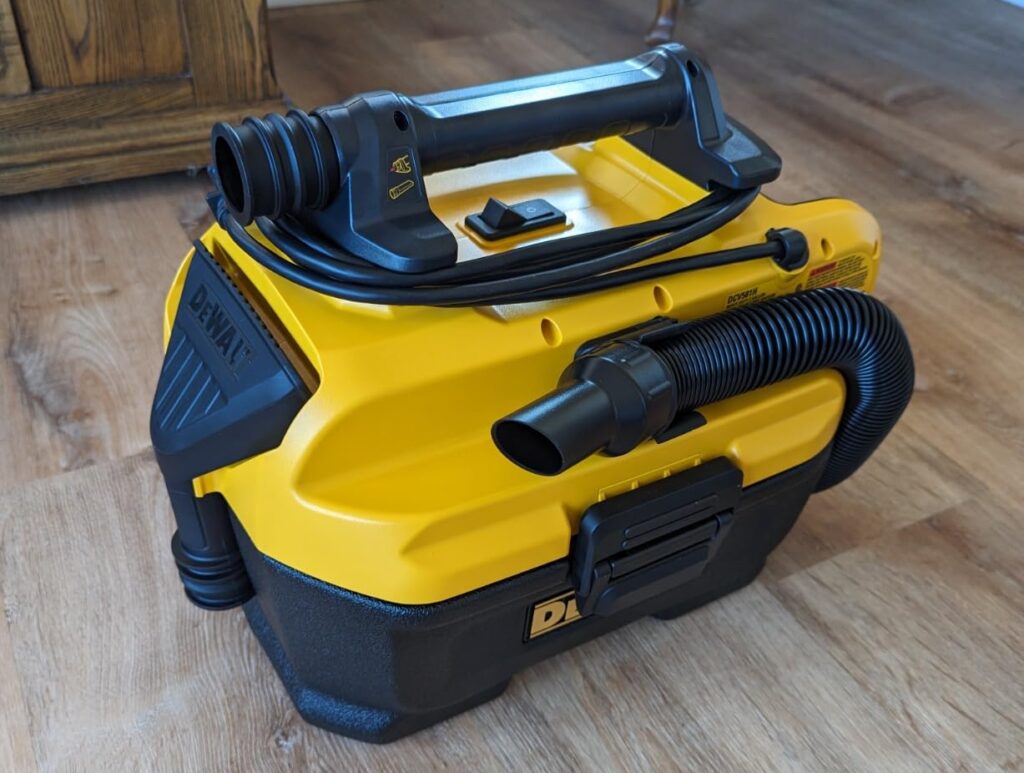
Remember that frustration I mentioned at the start? Let’s dig into it because this affects your daily use more than any spec sheet difference.
Both the DeWalt DCV580H vs DCV581H have their exhaust port positioned on the same side as the hose connection. The hose is only 5 feet long, so naturally, you end up working with the vacuum fairly close to your cleanup area. The result? The exhaust blast hits your work surface, scattering lightweight debris like sawdust, wood shavings, or drywall dust.
One user put it perfectly: “The exhaust port is located on the same side where the suction hose comes out… so the natural way to use the vac has you blowing exhaust directly at your work area.”
This is especially problematic when:
- Cleaning inside cabinets or closets (the exhaust bounces right back)
- Working on detailed finish carpentry (your carefully swept sawdust goes airborne again)
- Vacuuming vehicle interiors (debris blows from one side to the other)
- Right-handed users specifically (the ergonomics make the exhaust issue worse)
The Workaround: Companies like LANMU sell exhaust port adapters ($15-30) specifically to solve this DeWalt design flaw. There are even 3D-printable solutions on Printables.com. The fact that an entire aftermarket exists just to fix the exhaust routing tells you everything about how widespread this problem is.
So here’s the reality: budget an extra $15-20 for an exhaust adapter regardless of which model you choose, or plan to position the vacuum awkwardly to keep the exhaust away from your work.
The Battery Indicator Blindspot
Here’s another design choice that’ll make you wonder what DeWalt was thinking: the 20V batteries install upside down on both models.
Why does this matter? Because you can’t see the LED charge level indicator without removing the battery. For a tool designed around quick, portable cleanups, this defeats the entire purpose. You’re either:
- Constantly removing and reinserting the battery to check charge levels
- Working blind until the vacuum suddenly dies mid-job
- Keeping a mental timer (spoiler: this never works)
It’s one of those small frustrations that compounds over time. Three months from now, you’ll be muttering about this design decision while fumbling to check your battery level for the 47th time.
DeWalt DCV580H vs DCV581H : The Actual Differences
Now that we’ve covered what’s the same (and frustrating) about both models, let’s talk about what actually separates them.
Power Options: The Core Distinction
DCV580H: Battery-only operation. You’re running on 18V or 20V MAX DeWalt batteries exclusively.
DCV581H: Hybrid power. Runs on the same batteries OR plug into standard 120V AC power with the included 5-foot cord.
At first glance, the hybrid option sounds like a no-brainer. But here’s what nobody mentions: if you rarely use the AC option, you’re carrying around extra AC/DC conversion components that add weight for no benefit.
One user calculated: “The one with a cord weighs around 50% more because it has to have extra heavy duty stuff and size to convert 120 VAC to 20 VDC.” Official specs list both at 8 lbs, but real-world measurements put the DCV581H at 9.1 lbs—a 13.75% increase.
When does AC power actually matter?
- Extended cleaning sessions where battery swaps would interrupt workflow
- Shop/garage use where you’re near an outlet anyway
- Professional use where battery death = work stoppage (HVAC techs, mobile repair, etc.)
- Limited battery collection where buying more batteries costs $80-120 each
If these scenarios don’t describe your use case, you’re paying $41 extra to carry around a heavier vacuum.
The HEPA Filter Question
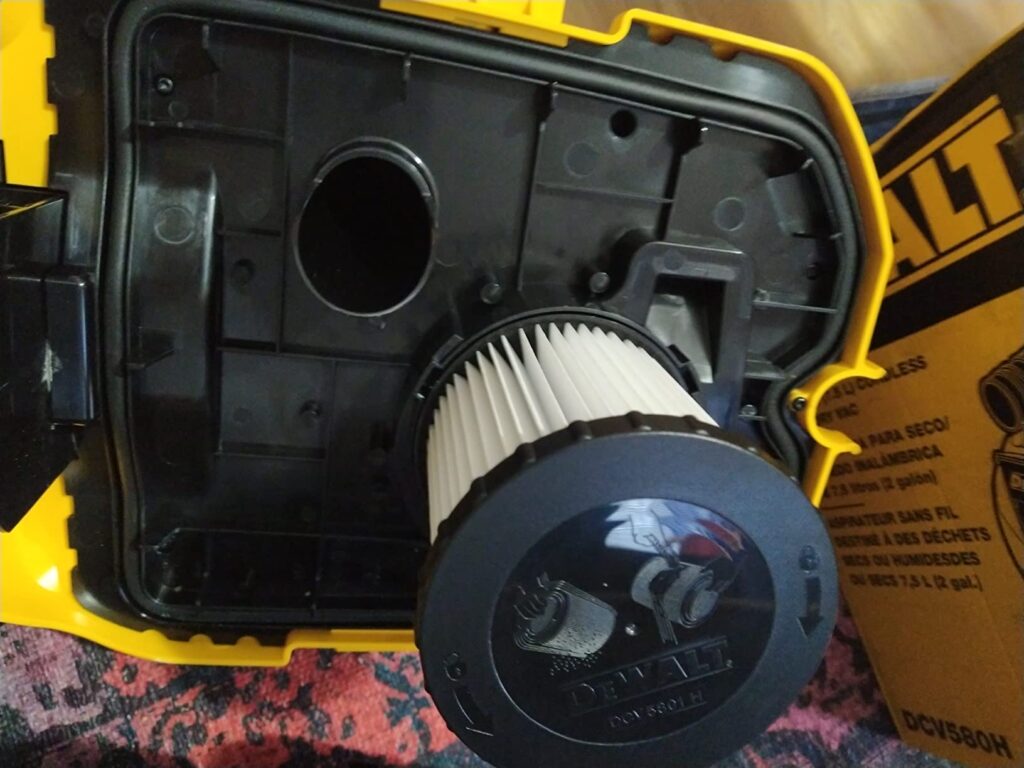
This is the other main differentiator:
- DCV580H: Standard washable, reusable filter
- DCV581H: HEPA-rated filter (99.97% efficiency at 0.3 microns)
HEPA filtration matters if you:
- Have allergies or respiratory sensitivities
- Do finish carpentry where fine dust is a concern
- Work with materials that produce irritating particles (fiberglass, drywall dust)
- Clean living spaces, not just workshops
Here’s the value calculation: aftermarket HEPA filters for the DCV580H cost about $15-20 for a 2-pack. So you’re really paying an extra $20-25 for the HEPA filter in the DCV581H (the rest of that $41 premium goes to the AC power capability).
If HEPA matters to you, it’s worth it. If you’re just cleaning up sawdust and wood chips in your shop? You probably won’t notice the difference.
Weight and Portability
The official specs list both at 8 lbs, but users consistently report the DCV581H feels noticeably heavier:
- DCV580H: 8.0 lbs
- DCV581H: 9.1 lbs (measured)
That extra 1.1 lbs might not sound significant, but when you’re:
- Carrying it up and down stairs
- Holding it at arm’s length to reach tight spaces
- Using it repeatedly throughout the day
…that 13% weight penalty adds up. To me it feels “50% heavier” in actual use, likely because the weight distribution differs due to the AC conversion components.
For truly portable, grab-and-go convenience, the DCV580H has a legitimate advantage here.
The Performance Reality: What 10 CFM Actually Means?

Let’s address the elephant in the room: both vacuums claim 31 CFM but deliver only 10 CFM according to independent testing.
What does this mean in practice?
What they handle well:
- Light sawdust and wood shavings
- General car interior cleaning (dirt, crumbs, small debris)
- Drywall dust and fine particles
- Quick spot cleanups
Where they struggle:
- Heavy debris like gravel or mulch
- Wet pickup (took one user “over 12 seconds to suction 2 gallons of water”)
- Large pieces of scrap material
- High-volume continuous vacuuming
The reality: these are ultra-portable convenience vacuums, not shop vac replacements. They excel at quick cleanups and spot work where running a corded shop vac would be overkill. But if you’re expecting to replace your 16-gallon shop vac with one of these, you’ll be disappointed.
For perspective, even budget shop vacs deliver 50-200+ CFM. These DeWalt models sit in a different category entirely—think of them as beefed-up handheld vacuums rather than miniaturized shop vacs.
Battery Runtime: The Numbers Nobody Publishes
DeWalt claims “15-45 minutes” of runtime, which is marketing speak for “we don’t want to commit to a number.”
Here’s what actual users report:
With a 2.0Ah battery:
- Heavy continuous use: Less than 10 minutes
- Intermittent spot cleaning: 15-20 minutes
With a 4.0Ah battery:
- Heavy continuous use: 25-30 minutes
- Intermittent use: 45+ minutes
With a 5.0Ah battery:
- Heavy use: 35-40 minutes (estimated from user reports)
- Intermittent use: 60+ minutes
One mobile RV tech shared: “The batteries would last less than 10 minutes, but you could get a whole lot of cleaning done in that time.”
The key insight: these vacuums work best for intermittent use. Vacuum for 30-45 seconds, move to the next area, repeat. Used this way, even a 2.0Ah battery gives you plenty of cleaning time. But if you’re trying to vacuum an entire workshop floor in one continuous session, even a 5.0Ah battery will drain quickly.
Here’s the hidden cost: Neither vacuum includes batteries. A single 5.0Ah battery costs $80-120. For the DCV580H especially, you need to factor this into your total investment:
- DCV580H: $158
- Plus 5.0Ah battery: $100
- Plus exhaust adapter: $20
- Real cost: $278
Suddenly that $41 difference between models seems smaller, doesn’t it?
Durability Concerns and Known Issues
Motor Control Board Failures (Both Models)
Multiple users report vacuums dying within 12 months with identical symptoms:
- Vacuum starts cycling on/off during use
- Performance becomes erratic (stuttering)
- Complete failure
The trigger seems to be fine dust (ironically, what these should excel at). The motor control board can’t handle sustained fine particle exposure, leading to thermal shutoffs and eventual failure.
Hose Durability Issues
The corrugated hose connects to plastic fittings that separate under tension.
This is exacerbated by the exhaust port problem—you’re forced to position the vacuum awkwardly, putting stress on the hose connection.
Clogging at the Inlet
The curved neck where the hose connects creates a choke point for larger debris. Users report frequent clogs with anything bigger than wood chips.
The 18V Battery Mystery
Here’s a contradiction I couldn’t fully resolve: most sources (including DeWalt’s specs) claim both models accept 18V and 20V MAX batteries. But one Amazon user specifically stated: “581H DOES NOT HAVE ABILITY TO USE 18 VOLT BATTERIES! 581H IS ONLY 20 volt, or 120 volt, NO 18 VOLT IS POSSIBLE.”
Multiple professional reviewers confirm 18V works on both models, so this might be:
- A specific production batch issue
- User error (trying old-style 18V instead of 18V MAX)
- An isolated defect
If you own legacy 18V tools, I’d verify compatibility before purchasing, especially for the DCV581H. The weight of evidence suggests it should work, but this user’s detailed claim raises questions.
Total Cost of Ownership

Let’s do the full math on what you’re actually spending:
Option 1: DCV580H Basic Setup
- Vacuum: $158
- 4.0Ah battery: $80
- Exhaust adapter: $20
- Total: $258
Option 2: DCV580H + HEPA Upgrade
- Vacuum: $158
- 4.0Ah battery: $80
- Aftermarket HEPA filter: $18
- Exhaust adapter: $20
- Total: $276 (vs. $199 for DCV581H before batteries)
Option 3: DCV581H Complete
- Vacuum: $199
- 4.0Ah battery: $80
- Exhaust adapter: $20
- Total: $299
So the real price difference isn’t $41—it’s about $23 once you factor in equivalent functionality. That puts the AC power capability at about a $23 premium, which seems more reasonable.
If you already own DeWalt batteries: The DCV580H at $158 becomes very attractive, especially if you don’t need HEPA filtration.
If you’re starting from scratch: The DCV581H at $199 gives you AC power as a backup while you build your battery collection.
Making the Decision: A Situational Breakdown
Forget the generic “buy this if you need X” advice. Here’s how to actually think through this decision:
Scenario 1: You’re a Weekend DIYer with a One-Car Garage
Best Choice: DCV580H
Why? You’re cleaning up occasional projects, you have access to outlets if you need extended runtime, and the lighter weight makes it easier to grab for quick cleanups. Save the $41 and put it toward a 4.0Ah battery. Add an aftermarket HEPA filter ($18) if allergies are a concern.
Total investment: $258 with battery
Current Price: $158
🏆Why buy it:
- Lightweight and easy to carry
- Perfect if you already own DeWalt 20V batteries
- Ideal for cars, workbenches, and quick cleanups
✅Best for: DIYers, mechanics, mobile detailing
⚠Watch out: No HEPA filter, battery-only operation
Scenario 2: You’re a Professional Contractor or Mobile Service Tech
Best Choice: DCV581H
Why? Battery death on a job site means work stops. AC power is your insurance policy. The HEPA filter helps when working in occupied homes. Yes, it’s heavier, but you need the reliability more than the portability advantage.
Total investment: $299 with battery backup
Scenario 3: You Already Own Multiple DeWalt 20V Tools (3+ Batteries)
Best Choice: DCV580H
Why? You’ve already solved the battery problem. AC power adds zero value since you can swap batteries instantly. Save the $41 and 1.1 lbs of weight. Your existing battery ecosystem is the vacuum’s power source.
Additional cost: $158 (vacuum only, maybe $20 for exhaust adapter)
Scenario 4: You Have Allergies or Do Finish Carpentry
Best Choice: DCV581H
Why? HEPA filtration isn’t a luxury for you—it’s necessary. While you can add aftermarket HEPA filters to the DCV580H, having it built-in ensures proper sealing and performance. The AC option is a bonus that lets you run longer cleaning sessions without battery anxiety.
Total investment: $299 with battery
Current Price: $199
🏆Why buy it:
- HEPA filtration for fine dust and allergies
- Can run plugged in when batteries die
- Better choice for professionals and indoor work
✅Best for: Contractors, allergy-sensitive users
⚠Watch out: Heavier and costs more
Scenario 5: You Clean Vehicles Professionally or Frequently
Best Choice: DCV580H (with reservations)
Why? The lighter weight matters when you’re constantly moving between vehicles. Battery power is perfect for mobile detailing. BUT—and this is important—both models have that exhaust port problem that’s particularly annoying in vehicle interiors. Budget for the LANMU exhaust adapter ($20) regardless of which you choose, or consider Milwaukee’s M18 vacuum instead, which has better exhaust positioning.
Total investment: $278 with battery and adapter
Scenario 6: You’re on a Tight Budget But Need a Cordless Vacuum Now
Best Choice: DCV581H (counterintuitively)
Why? At $199, you can plug it in and use it immediately. You don’t need to spend $80-100 on batteries right away. Build your battery collection over time as budget allows. This makes the higher upfront cost actually the lower entry point for immediate usability.
Immediate cost: $199 (ready to use)
Scenario 7: You Want One Vacuum for Both Shop and House
Best Choice: Neither (honestly)
Why? These excel at portable spot cleaning but lack the power for whole-house or full-shop vacuuming. The 10 CFM output and 2-gallon capacity mean you’ll be constantly emptying the tank and swapping batteries. You’ll end up frustrated. Get a proper shop vac for heavy duty work and maybe a DCV580H for quick cleanups between major jobs.
Alternative: Keep your corded shop vac, add DCV580H for convenience
What DeWalt Should Fix (But Probably Won’t)
Since this is an honest conversation, let’s talk about what makes these vacuums frustrating despite being genuinely useful:
- Relocate the exhaust port to the opposite side or top of the unit
- Install batteries right-side-up so the charge indicator is visible
- Improve the hose connection so it doesn’t separate under normal use
- Be honest about CFM ratings (10 CFM, not 31)
- Redesign the inlet curve to reduce clogging on larger debris
- Add a battery charge indicator built into the vacuum body
None of these require revolutionary engineering. They’re basic quality-of-life improvements that would eliminate 90% of user complaints.
The Bottom Line: DeWalt DCV580H vs DCV581H
Here’s what I wish someone had told me before I started researching these vacuums:
They’re both genuinely useful tools that will frustrate you regularly. The exhaust port design is infuriating. The battery indicator placement is nonsensical. The CFM claims are misleading. And at current prices, the $41 premium for the DCV581H is harder to justify than it was when these were within $10 of each other.
But—and this is important—if you set proper expectations, they’re excellent at what they actually do well: quick, portable cleanups where dragging out a corded shop vac would be overkill. Car interiors, workbench cleanup, spot messes, small projects. That’s their wheelhouse.
FAQs
Q1: What’s the main difference between DeWalt DCV580H vs DCV581H?
DCV580H is battery-only, while DCV581H adds AC corded power and a HEPA filter.
Q2: Do both models have the same suction power?
Yes. Real-world testing shows both perform nearly identically.
Q3: Is the DCV581H worth the extra money?
Only if you need HEPA filtration or AC backup power.
Q4: Can I use DeWalt 20V MAX batteries with both?
Yes, both work with DeWalt 20V MAX batteries.
Q5: Are these good replacements for a shop vac?
No. They’re best for quick cleanups, cars, and light debris.
Q6: Which one is lighter to carry?
DCV580H is lighter and easier for grab-and-go use.