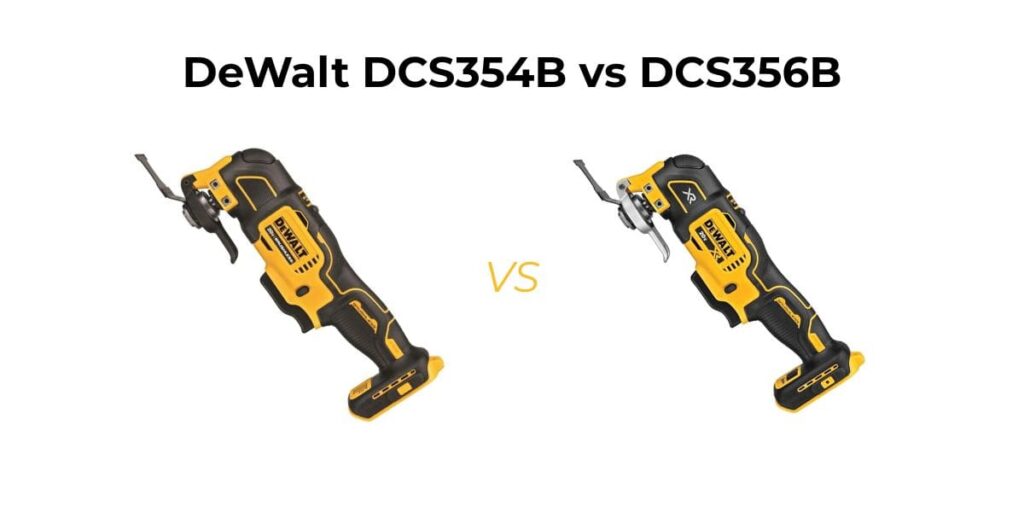
 Best For: DIYers, light tasks
 Includes: Tool + Battery
 Price: $111


- BEST IF YOU HAVE DEWALT BATTERIES: DCS356B
- Includes: Bare tool only!
- Price: $104

Introduction
Here’s something odd: the DCS356B is currently $104 on Amazon, while the DCS354B sits at $111. That doesn’t make sense at first glance. The 356 is technically the upgraded model with more features. What’s going on?
It comes down to market positioning and how Home Depot, Lowe’s, and Amazon price their tools. The DCS354B is part of DeWalt’s ATOMIC line—their compact series that’s everywhere in stores. It’s heavily marketed, constantly featured in combo kits, and retailers know people will pay for that compact form factor. The DCS356B belongs to the XR line, which is DeWalt’s premium tier, but it doesn’t get the same retail push. Sometimes being the “better” tool on paper means worse shelf placement.
The real question isn’t which costs more—it’s which solves your problem.
Table of Contents
At-a-glance Specs: DeWalt DCS354B vs DCS356B
| Features | DCS356B 🏆 | DCS354B |
|---|---|---|
| Price | $104 | $111 |
| Max Speed | 20,000 OPM | 18,000 OPM |
| Speed Control | 3-speed selector + trigger | Variable trigger only |
| Speed Settings | Low (0-13K), Med (0-17K), High (0-20K) | 0-18,000 continuous |
| Series | XR (Premium) | Atomic (Compact) |
| Weight | 2.6 lbs (tool only) | 2.3 lbs (tool only) |
| Belt Clip | Yes ✓ | No |
| Overall Rating | ⭐⭐⭐⭐⭐(4.9/5) | ⭐⭐⭐⭐(4.5/5) |
| Where To Buy | Check On Amazon | Check On Amazon |
DCS354B vs DCS356B: What Actually Separates These Tools?
Forget the marketing lines about “ultimate speed control” and “brushless efficiency.” Both have brushless motors. Both run on 20V MAX batteries. Both use Quick-Change blade systems. Here’s what genuinely differs:
The DCS354B gives you: Variable speed from 0-18,000 OPM through the trigger only. You squeeze harder, it goes faster. Release pressure, it slows down. That’s it. It’s 11.2 inches long, weighs 2.3 lbs, and fits in tighter spaces.
The DCS356B gives you: Three distinct speed ranges (13,000 / 17,000 / 20,000 OPM maximum), PLUS the variable trigger within each range. It’s slightly heavier at 2.6 lbs but has that extra top-end speed for aggressive material removal.
Related Articles:
When the 3-Speed Switch Actually Matters?

Most comparison articles make a big deal about the 3-speed selector. Let me tell you when it genuinely helps and when it’s just nice to have:
It matters for cutting metal. When you’re removing rusted bolts, cutting through nails embedded in wood, or working with sheet metal, starting at low speed prevents blade chatter and premature wear. You can set it to low, squeeze the trigger fully, and have consistent control. With the DCS354B, you’re trying to feather the trigger to maintain that low speed, which gets exhausting after 20 minutes.
It matters for detail sanding. Refinishing furniture? Sanding between coats of polyurethane? Set the 356 to medium and maintain that speed without thinking about it. Your hand doesn’t fatigue from holding partial trigger pressure.
It doesn’t matter for most cutting tasks in wood, drywall, or PVC. For trimming door jambs, cutting access holes, or removing grout, the single-speed range on the DCS354B handles it fine. You’re not holding the trigger at partial pressure long enough for it to matter.
The Compact Factor People Undervalue
DeWalt markets the DCS354B as “ATOMIC” which sounds like marketing nonsense, but the 11.2-inch length genuinely helps in real scenarios. Cutting behind installed cabinets, working between studs, reaching into tight automotive engine bays—that compact profile makes impossible jobs merely difficult.
The DCS356B at 11.8 inches (estimated based on similar XR tools) doesn’t sound much bigger. It’s just over half an inch. But half an inch becomes the difference between “barely fits” and “doesn’t fit” when you’re wedged into a crawl space or reaching behind a toilet.
Power Output: The Spec Sheet Lies
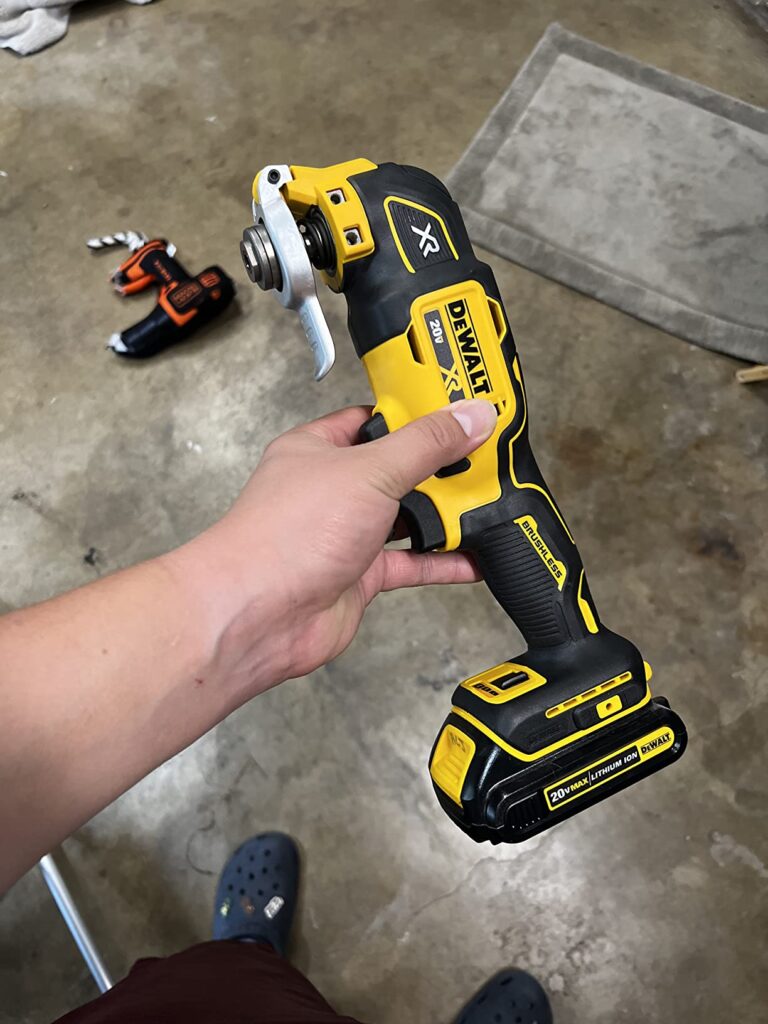
Spec sheets say both deliver “similar” performance. That’s technically accurate but meaningfully misleading.
The DCS356B hits 20,000 OPM at its high setting. The DCS354B tops out at 18,000 OPM. That 2,000 OPM difference shows up when you’re removing old adhesive, grinding mortar joints, or scraping paint off metal. The 356 chews through it faster. Not life-changing faster, but “saves 15 minutes on a bathroom tile removal” faster.
For cutting? Both slice through 2x4s, plywood, and drywall at essentially the same speed. The limitation there is usually blade quality, not motor speed.
The Hidden Cost: Blade Wear
Here’s something nobody mentions: the higher speed ceiling on the DCS356B wears out blades faster IF you constantly run it at maximum. Wood-cutting blades get hot. Hot blades dull fast.
If you’re the type who cranks every tool to maximum “because more power is always better,” the DCS354B actually saves you money on blades. Its 18,000 OPM ceiling prevents you from cooking your cutting edges as quickly.
If you’re disciplined about speed selection, the DCS356B lets you match the tool to the task, which extends blade life.
Battery Consumption: They’re Nearly Identical
Both draw similar current under similar loads. Your 2.0Ah battery will give you roughly 40-50 minutes of active cutting time on either tool. The XR branding on the 356 doesn’t translate to better efficiency here—they’re using virtually the same motor technology.
Where the DCS356B can save battery: using the low-speed setting for sanding or scraping instead of running high-speed needlessly. But that requires you to actually switch speeds, which many people forget to do.
Ergonomics: Subtle But Real

The DUAL-GRIP trigger system on both tools is identical. Both have LED work lights. Both have rubber overmolding. The physical handling is 90% the same.
The 10% difference? That extra 0.3 lbs on the DCS356B sits mostly in the motor housing. During overhead work, it tips the balance point slightly forward. Not enough to cause problems, but enough that you notice after 30 minutes of ceiling work.
The DCS354B’s lighter weight makes it less fatiguing for extended use in awkward positions. If you’re a contractor working overhead daily, that matters. For weekend projects, it’s barely perceptible.
Vibration: Marketing Claims vs. Reality
DeWalt claimed the DCS356B has “reduced vibration” compared to older models. Independent testing showed it’s marginally better—roughly 10% less vibration than the DCS355 (the older model). The DCS354B has similar vibration levels.
Translation: Both tools vibrate about the same. Neither will give you white finger syndrome from occasional use. Neither is notably smoother than the other. Wear gloves if vibration bothers you.
Accessory Compatibility: Complete Overlap

Both use DeWalt’s Universal Accessory Adapter. Both accept OEM DeWalt blades, Bosch blades, Fein StarLock blades, and generic universal-fit accessories. There’s zero advantage to either tool here.
Noise Levels: Basically Identical
Both produce around 80-85 dB under load. That’s “hearing protection recommended” loud, but not “damage your hearing immediately” loud. The DCS356B’s higher top speed makes it slightly louder at maximum, but we’re talking 1-2 dB difference—imperceptible without measuring equipment.
Real-World Scenario Testing: DCS354B vs DCS356B
Let me walk through specific projects and which tool performs better:
Installing Luxury Vinyl Plank Flooring: You need to trim door jambs. Both tools handle this identically. The tighter space under some doors favors the DCS354B slightly. Edge: DCS354B
Removing Ceramic Tile: Cutting through grout and old thinset. The DCS356B’s higher top speed removes material faster. Set it to high, let it eat. Edge: DCS356B
Automotive Work (Removing Rusted Exhaust Bolts): The low-speed setting on the DCS356B prevents blade breakage on hardened steel. Edge: DCS356B
Trimming PEX Pipe in Tight Spaces: Both cut PEX like butter. The compact size wins here. Edge: DCS354B
Sanding Wood Filler Between Coats: Medium speed on the DCS356B gives you more control than feathering the trigger constantly. Edge: DCS356B
Cutting Drywall Access Panels: Identical performance. Neither has an advantage. Edge: Tie
The Professional vs. DIYer Angle (But Not How You Think)
Most articles say “professionals need the DCS356B, DIYers can save money with the DCS354B.” That’s lazy thinking.
Get the DCS354B if: You value compact size because you work in residential remodeling with limited access. You don’t want to think about speed settings—you just want to grab it and cut. You already own ATOMIC-series tools and like the ecosystem consistency.
- Best For: DIYers, light tasks
- Includes: Tool + Battery
- Price: $111
Get the DCS356B if: You regularly work with metal or do tile removal. You appreciate fine-tuned control over tools. You work on projects where the extra $7 (current pricing) is meaningless but the features matter.
Professional contractors I know are split 50/50 on these tools. Some swear by the ATOMIC for its size. Others love the XR’s versatility. It’s genuinely about work style, not skill level.
- BEST IF YOU HAVE DEWALT BATTERIES: DCS356B
- Includes: Bare tool only!
- Price: $104
The Pricing Anomaly Strategy
Since the DCS356B is currently cheaper, here’s the smart play: buy the DCS356B now at $104. If you find the 3-speed switch annoying or never use it, you can always ignore it and just squeeze the trigger like the DCS354B. You’ve lost nothing.
If the DCS354B were significantly cheaper (say, $80 vs. $110 for the 356), then the compact size becomes a value proposition. At current pricing? The DCS356B gives you more capability for less money.
But monitor prices. Tool prices fluctuate wildly based on retailer promotions. By next month, this could flip entirely.
What DeWalt Won’t Tell You?
Both these tools replaced the DCS355, which was the standard oscillating tool for years. DeWalt created the ATOMIC line to capture the “compact tool” market and the XR line to be their premium tier. They’re essentially the same internal motor with different housings and control boards.
The DCS354B’s single-speed design is simpler, which theoretically means fewer electronic components to fail. The DCS356B’s 3-speed selector adds a mode switch and additional programming. Over a 5-year lifespan, will that matter? Probably not. DeWalt’s quality control is solid. But it’s worth knowing you’re paying for electronics, not fundamentally better mechanics.
Warranty and Support: Identical
Both have DeWalt’s 3-year limited warranty. Both have the same parts availability. Both are serviced at the same authorized service centers. No advantage either way.
The Final Analysis: DCS354B vs DCS356B
Stop thinking about this as “which tool is better.” Think about it as “which tool fits how I work.”
You need the DCS354B if compactness is genuinely critical to your work. If you’re constantly in tight spaces, overhead in attics, or working between studs, the smaller size earns its keep daily.
You need the DCS356B if you work with diverse materials and appreciate tool control. The 3-speed switch isn’t a luxury—it’s practical functionality when you’re transitioning between cutting metal and sanding wood in the same project.
At current pricing ($104 for the 356 vs. $111 for the 354), the value proposition leans toward the DCS356B for most people. You’re getting more tool for less money. Unless you specifically need that ultra-compact form factor, the XR model makes more sense.
But check prices before buying. Tool pricing changes weekly based on retailer inventory and promotions. Make your decision based on features and fit for your work, not on a temporary $7 price difference.
Buying Advice That Actually Helps
- Best For: DIYers, light tasks
- Includes: Tool + Battery
- Price: $111
If you own zero DeWalt tools: Get whichever is cheaper that day, buy a 5.0Ah battery separately, and focus your money on quality blades. The tool matters less than the accessories.
If you’re deep in the DeWalt ecosystem: The ATOMIC DCS354B matches your other compact tools aesthetically. The XR DCS356B matches your other premium tools. Pick based on what’s already on your shelf.
If you’re replacing a corded oscillating tool: Either cordless option will feel like a revelation. The freedom from cords matters infinitely more than the difference between these two models.
The Bottom Line
The DCS354B is a fantastic oscillating tool. The DCS356B is also a fantastic oscillating tool. Neither is “better”—they serve slightly different needs.
The 3-speed selector on the DCS356B adds genuine value for metal work and fine control. The compact size of the DCS354B adds genuine value for tight-space work. Everything else is marketing noise.
At current pricing, the DCS356B at $104 represents better value. But if the DCS354B drops to $90 and you need compact size, grab it without hesitation.
Buy based on your specific needs, not on which has fancier specs. Both tools will serve you well for years.
FAQs
Is the 2,000 OPM speed difference noticeable?
Yes, particularly in demanding materials. User reviews on Amazon mention the DCS356B cuts hardwood and metal noticeably faster. For softwood and drywall, both tools perform similarly.
Why does the DCS354B weigh less?
The DCS354B is part of DeWalt’s Atomic compact series, designed with slightly smaller components. The 0.3 lb difference (2.3 vs 2.6 lbs) is noticeable during overhead work but not significant for most tasks.
Does the 3-speed selector really matter?
According to user feedback, yes—especially for extended operations. Setting a max speed lets you fully squeeze the trigger without worrying about going too fast. This reduces hand fatigue during long jobs like grout removal or cabinet sanding.
For quick 30-second cuts, the variable trigger on both tools works fine.
Can both use the same accessories?
Yes. Both tools accept universal oscillating tool accessories with the standard mounting interface. DeWalt, Bosch Starlock, Fein, Milwaukee, and generic blades all fit both models.
Which one is better for cutting plywood?
The DCS356B’s higher speed (20K OPM) cuts plywood faster, especially in multiple passes or thick material. The DCS354B handles plywood fine but takes slightly longer.
Do I need the XR model if I’m a DIYer?
Depends on your projects. Weekend warriors doing occasional trim work or small repairs will be happy with the DCS354B. DIYers tackling major renovations (full bathroom remodel, hardwood floor installation, deck building) benefit from the DCS356B’s extra capability.
Which one is quieter?
User reviews suggest the DCS356B runs slightly quieter, though both require hearing protection for extended use. The DCS356B’s XR design includes vibration reduction that contributes to a smoother, quieter operation.