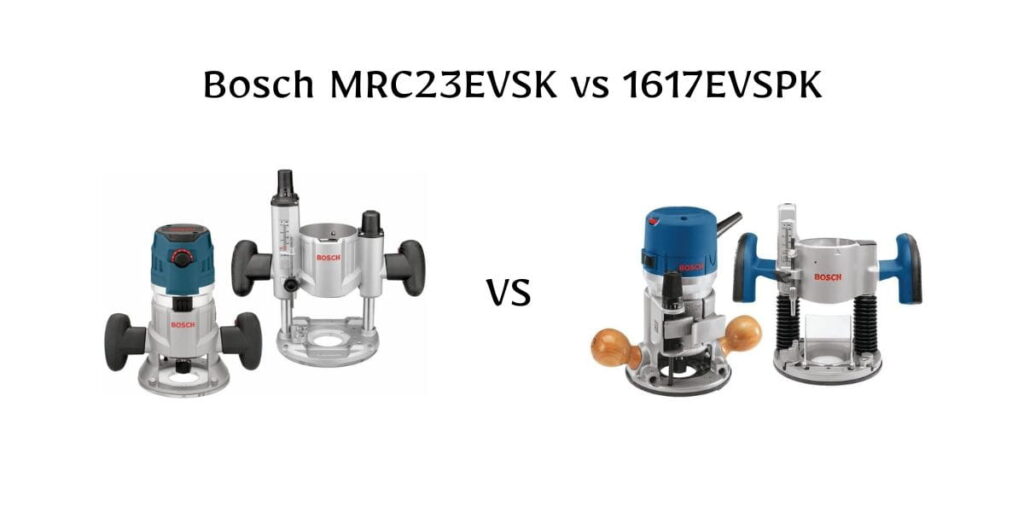
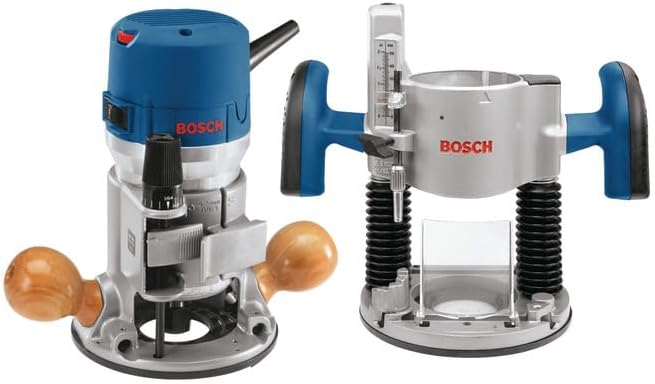
Current Price: $269
Best for: Router tables, all-around shop use, beginners to intermediate woodworkers
✅ Fixed + plunge base combo | Full router lift compatibility | Above-table bit changes | Edge guide included
❌ Switch will need replacement eventually (easy $15 fix)

Current Price: $349
Best for: Freehand routing, mortising, inlay work, plunge-heavy tasks
✅ Fixed + plunge base combo | Handle-trigger switch | Always-on LED lights | 15A motor
❌ Not recommended if you plan to use a router table or router lift
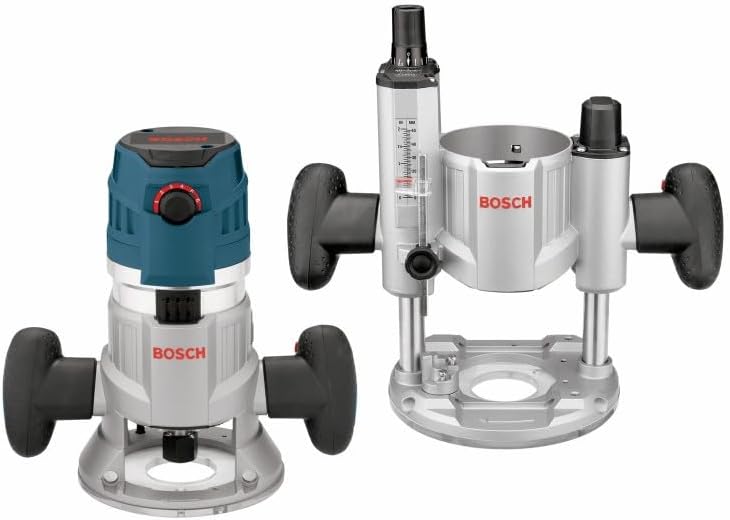
Introduction
Here’s the conversation that plays out across dozens of woodworking forums, almost word for word.
Someone buys the Bosch MRC23EVSK. Loves it. Spends $349 on what feels like a premium, future-proof router. Six months later, they start thinking about a router table. They ask around. And then they find out.
The router they bought — the one with the trigger in the handle, the LEDs, the slick modular design — can’t be used with a router lift. Not without a zip tie, a bypass switch, or a workaround Bosch’s own customer service suggested. And by that point, they’re buying a second, dedicated router just for the table, keeping the MRC23 for manual work only — exactly the kind of double purchase nobody budgeted for.
That’s the story every comparison article on Google skips right over. They’ll tell you the MRC23 has 15 amps and the 1617 has 12. They’ll paste a spec table. They’ll say “the MRC23 is better for professionals” or some other vague verdict that tells you nothing about what actually matters.
This article is different. By the end of it, you won’t just know which router to buy. You’ll know why — and you’ll understand the $80 price gap in a way that might completely flip your thinking.
Table of Contents
TL;DR
The 1617EVSPK ($269) is the smarter buy for most woodworkers — it works flawlessly in a router table and costs $80 less. The MRC23EVSK ($349) is more refined for freehand work but has a serious router table compatibility problem nobody talks about. Unless you’ll never use a router table, save the $80.
Related Articles:
At-a-glance: Bosch MRC23EVSK vs 1617EVSPK
| Features | MRC23EVSK | 1617EVSPK |
|---|---|---|
| Price | $349 | $269 |
| Amperage | 15A | 12A |
| Speed Range | 8,000–25,000 RPM | 8,000–25,000 RPM |
| Collets Included | ¼" & ½" | ¼" & ½" |
| Router Table Compatible | ⚠️ Limited | ✅ Fully |
| Router Lift Compatible | ❌ No | ✅ Yes |
| LED Work Lights | ✅ Yes | ❌ No |
| Plunge Lock | ✅ Spring-loaded | Manual |
| Switch Location | Handle (ergonomic) | Motor body |
| Known Weakness | Table incompatibility | Switch wear |
| Best For | Freehand / plunge work | All-around / table use |
| Where To Buy | Check On Amazon | Check On Amazon |
Let’s Start With the Problem You’re Actually Trying to Solve
Most people searching “Bosch MRC23EVSK vs 1617EVSPK” are trying to answer one of three questions:
“Is the $80 premium on the MRC23 worth it?” “Which one is better for a router table setup?” “I’m about to buy one — help me feel confident I’m not making a mistake.”
The answer to all three is the same: it depends entirely on how you plan to use the router. But not in the wishy-washy way comparison articles always mean when they say that. It depends in a very specific, structural way — and once you understand it, the decision becomes obvious.
What These Routers Actually Are? (And How They’re Different Where It Counts)
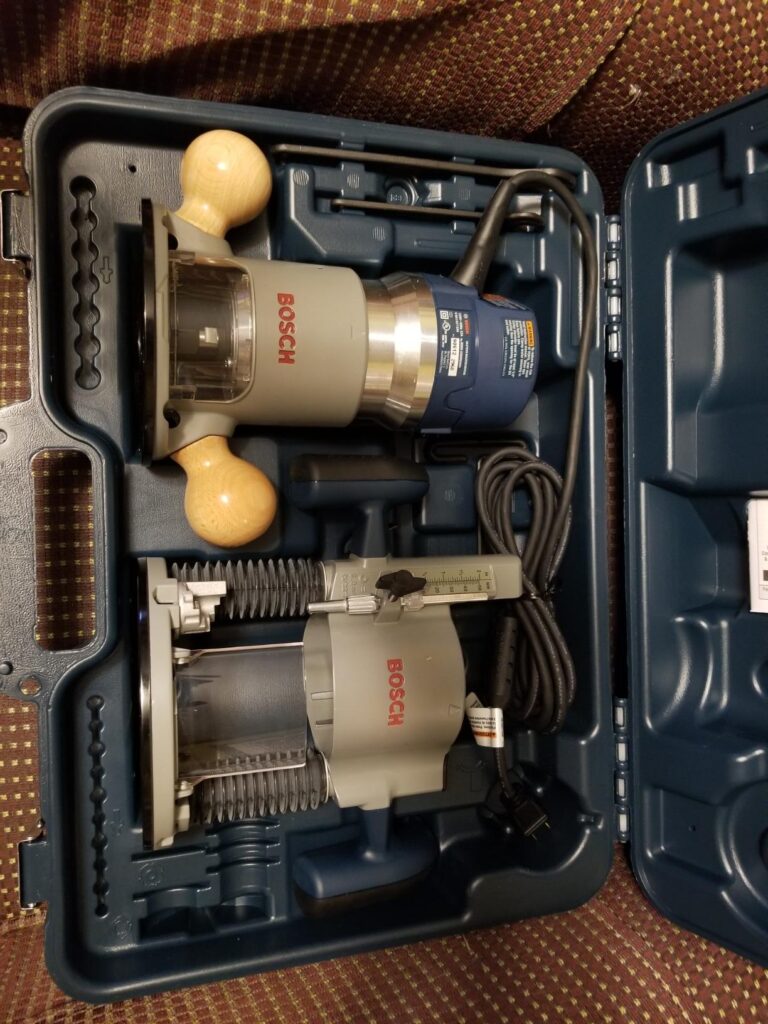
Both are Bosch combo kits. Both come with a fixed base and a plunge base. Both accept ¼-inch and ½-inch collets. Both have variable speed, soft-start, and constant-response circuitry that adjusts to load. So far, so similar.
But here’s where they actually diverge — and it’s not the horsepower rating.
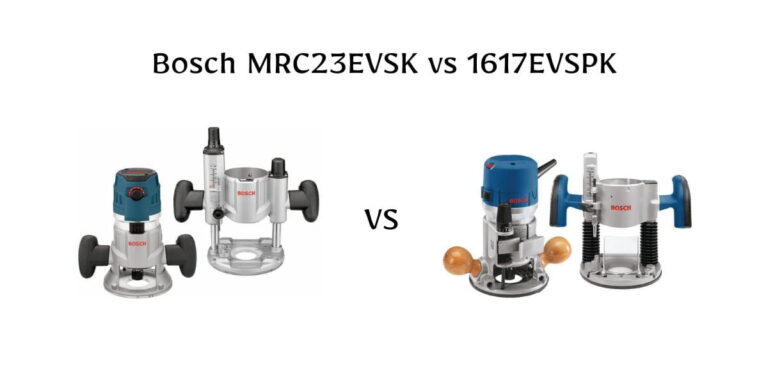
The MRC23EVSK is built around Bosch’s modular motor architecture. The trigger switch lives in the handles. To make that work across different bases, Bosch uses a contact bus system — four metal contact bars on the motor unit that mate with matching contacts in whatever base you attach. The motor, on its own, cannot be switched on. The power flows through the base. This is a genuinely clever design for freehand routing. Both hands stay on the handles at startup and shutdown. The LED work lights are always on once the router is plugged in (not tied to the motor), so you can see your layout before you fire up the bit. The microfine depth adjustment on the fixed base is excellent. The plunge base has a spring-loaded lever that locks on release. The switch placement on the handle means both hands are on the router during start-up and shut-down, which makes more ergonomic sense than a switch on the motor body.
At $349 on Amazon right now, it’s a polished machine. For handheld routing, it’s arguably the nicer router to operate.
The 1617EVSPK is Bosch’s older-generation workhorse — and “older” is not a criticism. The switch lives on the motor body. The motor can be detached from the base and will still accept an external switch signal. The collet can extend above the table for easy above-table bit changes. The motor slides between the fixed and plunge bases with a twist, held by two alignment arrows. The fixed base has threaded holes specifically designed for table mounting. At $269 on Amazon, it’s $80 less.
It’s less exciting to talk about. It’s also more useful for more people.
The Router Table Problem Nobody Tells You About
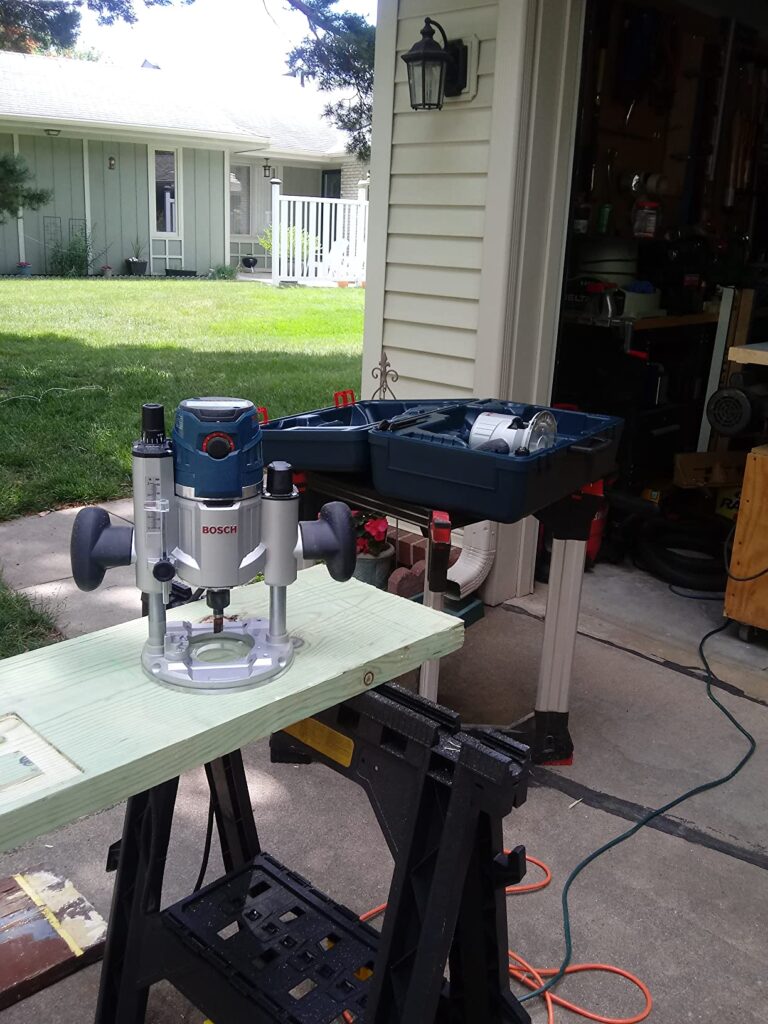
This is the part that changes everything.
The MRC23EVSK’s power switch is built into the handles, using a contact bus system between the motor and base — meaning without the base attached, there is no way to turn the router on and off.
What does that mean for a router table? A lot.
When you mount a router in a table, you typically drop the motor unit into a router plate or a router lift. The whole point of a lift is that you can raise and lower the bit from above the table — it’s one of the biggest quality-of-life upgrades in shop work. But router lifts grip the motor unit directly. There is no lift on the market that accommodates the MRC23EVS, because its power switch is built into the handles— and a lift can’t replicate that contact bus system.
So what are your options with the MRC23 in a table?
Bosch’s official workaround? A zip tie on the trigger, paired with an external power switch. That’s the solution Bosch customer service offered to users who called in asking about this exact problem.
Some users have bypassed the switch entirely — connecting the leads directly and running power to an external switch on the table. It works. But you’ve now voided your warranty, you’ve lost the soft-start function (which is controlled downstream of the switch), and you’ve done serious electrical modification to a $349 tool.
Others have reported the MRC23 stopping mid-job when mounted in a table, with no way to restart it — and then starting again on its own, sometimes cycling on and off periodically. Replacing the switch in the base didn’t help. The contact bus system that makes the MRC23 elegant for freehand use becomes a liability when it’s mounted upside-down, collecting dust, vibrating constantly, in a configuration it wasn’t really designed for.
The 1617EVSPK, meanwhile, just… works in a table. It has done so, reliably, for woodworkers who’ve had the same router mounted for over a decade. The 1617EVSPK was specifically noted to have a built-in feature allowing router bit height adjustment in a router table from above the table — something the MRC23’s design makes cumbersome at best.
This isn’t a minor inconvenience. For anyone who sees a router table in their future — even a year or two down the road — it’s a fundamental design incompatibility.
The Switch Problem on the 1617 (Because Honesty Matters)
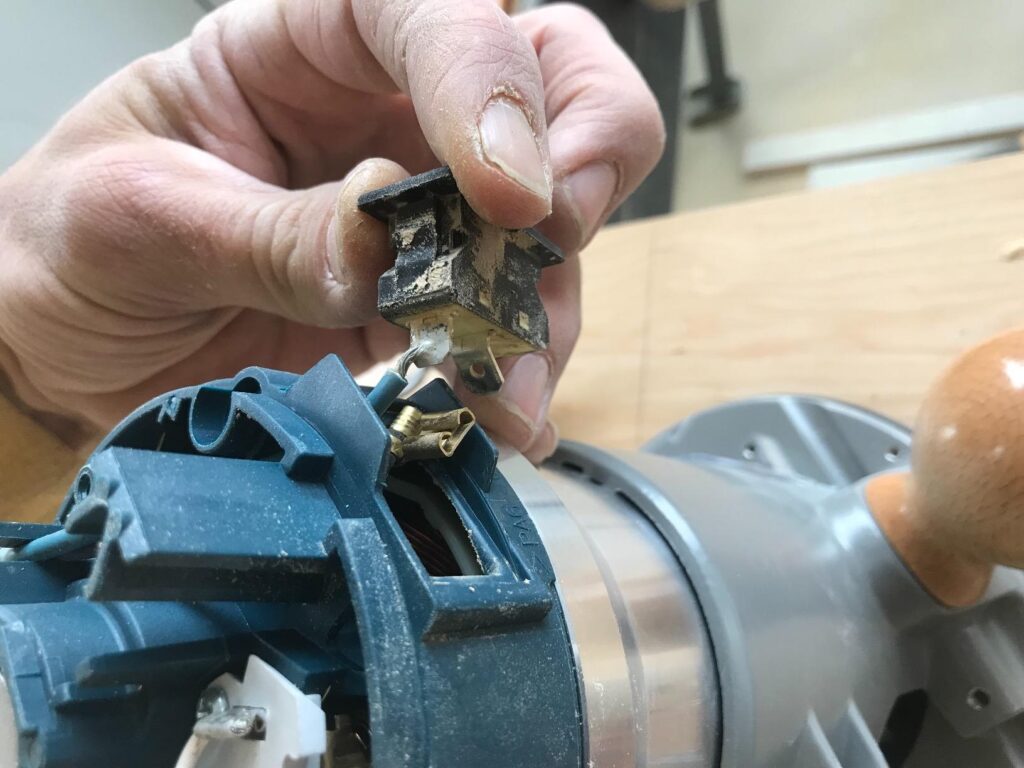
The 1617 isn’t perfect either, and this is where most comparison articles stay suspiciously quiet.
The power switch on the 1617 will fail. Amazon even sells replacement switches in a two-pack, which essentially confirms that Bosch and the market have acknowledged this is a recurring issue.
The switch is not fully sealed, so sawdust accumulates inside and causes failure. Bosch will replace it under warranty, but the replacement is the same part — so the problem can return.
Some users have had switch contacts burn and pit severely, with the size of the contact point appearing undersized for the amperage it’s handling.
Here’s the honest take: this is a real flaw, documented across multiple woodworking forums since at least 2005 and still appearing in Amazon reviews in 2023. But it’s also a manageable flaw. The switch is super easy to replace and the router will do just about anything you ask of it — reviewers still recommend it despite the issue. The replacement switch costs less than $15. If the router is table-mounted, most woodworkers bypass the switch entirely and use the table’s own power switch — which eliminates the problem completely and is actually a better workflow anyway.
The 1617’s switch problem is the kind of flaw that’s annoying the first time, then becomes routine maintenance. The MRC23’s table compatibility problem is the kind of flaw that makes you buy a second router.
Those are not equivalent problems.
Breaking Down the Specs That Actually Matter
Power: The MRC23EVSK runs at 15 amps. The 1617EVSPK runs at 12 amps. This sounds like a big gap on paper. In practice, most experienced woodworkers note that you shouldn’t be pushing cuts that require the full difference between 12 and 15 amps — and if you are, the solution is a lighter pass, not more motor. For cabinet doors, dado slots, edge profiles, mortises, and decorative work — the bread and butter of routing — the 1617’s 2.25 HP is more than adequate. The 3 extra amps on the MRC23 are meaningful for production shops running large panel bits for extended sessions. For everyone else, it’s largely theoretical.
Speed range: Both routers offer variable speed from 8,000 to 25,000 RPM. Both have constant-response circuitry that maintains speed under load. This is a draw — both perform well here.
Collet compatibility: Both accept ¼-inch and ½-inch collets. This covers the overwhelming majority of router bits on the market.
Weight: The MRC23EVSK is heavier. Not dramatically, but noticeably for extended freehand sessions. This matters if you do a lot of edge work on large panels or overhead routing.
Plunge base: Both have plunge bases. The MRC23’s spring-loaded plunge lock is genuinely better — it locks on release rather than requiring a separate manual lock. For mortising, template work, and stopped grooves, this is a real ergonomic advantage. If plunge routing is a significant part of your workflow, the MRC23 earns some of its premium here.
LED lights: The MRC23’s always-on LEDs (active whenever the router is plugged in, not just when running) are a genuine quality-of-life feature for layout visibility. The 1617 has no LED lighting.
Microfine depth adjustment: Both bases offer this. The MRC23’s implementation is considered slightly more precise by most users.
Kit contents: Both are combo kits (fixed and plunge bases, collets, wrenches, carrying case). The 1617EVSPK adds an edge guide and circle cutter, which are legitimately useful accessories. The MRC23EVSK does not include these.
Bosch MRC23EVSK vs 1617EVSPK: The Real Price Comparison
Current Amazon prices: MRC23EVSK at $349, 1617EVSPK at $269. That’s an $80 gap.
Here’s what $80 buys in the woodworking world:
- A quality set of carbide-tipped router bits (spiral upcut, roundover, chamfer, cove — the ones you’ll actually use)
- The Bosch edge guide RA1054 (around $40) and a set of bits
- A router table insert plate for the 1617 to get it table-ready
- About 80% of a basic router table if you buy components carefully
The MRC23 does offer more for its price in a vacuum — better plunge mechanism, handle-mounted switch, LEDs, more power. If both routers cost the same, the choice would be harder. But they don’t cost the same. And the $80 you save with the 1617 buys you things that make your woodworking better immediately.
If you buy the MRC23 and then later realize you need it in a table, you’ll spend more than $80 solving that problem — either buying a separate router for the table, or doing electrical modifications, or using a zip-tie workaround that makes you feel like a person who zip-ties their router.
Who Should Buy the Bosch MRC23EVSK ($349)?
Current Price: $349
Best for: Freehand routing, mortising, inlay work, plunge-heavy tasks
✅ Fixed + plunge base combo | Handle-trigger switch | Always-on LED lights | 15A motor
❌ Not recommended if you plan to use a router table or router lift
The MRC23 makes sense for you if most or all of the following are true:
You do a lot of freehand plunge routing — mortises, inlay work, template routing on the bench, stopped flutes. The handle trigger and spring-lock plunge base make this work noticeably more comfortable.
You never plan to use a router table, or you already own a separate dedicated router for your table. If the MRC23 is joining a shop that already has a table router, it’s genuinely excellent as a standalone handheld unit.
You do heavy production work — extended sessions through hard maple, walnut, thick stock — and the extra amperage will earn its keep. A kitchen cabinet shop running continuous production is a good home for this router.
You value ergonomics and refinement over compatibility. The MRC23 is simply a more pleasurable router to use freehand. The LEDs, the plunge lock, the handle switch — these are thoughtful details that add up over a long day in the shop.
You are committed to the Bosch RA1171 router table ecosystem specifically, which was designed around the MRC23 and handles the contact bus system with a dedicated mounting solution. This is the one table setup where the MRC23 works as intended.
Who Should Buy the Bosch 1617EVSPK ($269)?
Current Price: $269
Best for: Router tables, all-around shop use, beginners to intermediate woodworkers
✅ Fixed + plunge base combo | Full router lift compatibility | Above-table bit changes | Edge guide included
❌ Switch will need replacement eventually (easy $15 fix)
The 1617EVSPK makes sense for you if most or all of the following are true:
You don’t know yet whether you’ll want a router table. This is a critical one. If there’s any chance — even a year from now — that you’ll want to mount this router in a table and use a router lift, the 1617 is the right choice by a wide margin. It’s designed for exactly that use.
You want a single router that handles everything: edge work, table routing, occasional handheld plunge work. The 1617 is versatile without compromise.
You’re a hobbyist or intermediate woodworker building furniture, cabinetry, trim work, or shop fixtures. The 12-amp motor is not a limitation for this work. You will not notice the 3-amp deficit.
You want to spend the $80 difference on bits, accessories, or a basic router table rather than on a more refined motor housing.
You’re setting up your first real router and want to maximize the value of your investment. The 1617 has a decades-long track record, a massive parts and accessories ecosystem, and a well-understood set of quirks. It’s a known quantity that woodworkers trust.
The Verdict: What the $80 Price Gap Is Really Telling You?
The MRC23EVSK is a better router for handheld work. That’s not marketing — it genuinely has better ergonomics, more power, and more thoughtful freehand features than the 1617.
But the 1617EVSPK is a better investment for most woodworkers.
Most woodworkers eventually want a router table. Most woodworkers don’t start their router journey knowing they’ll want one. The 1617 gives you the flexibility to go either direction — keep it handheld indefinitely, or drop it in a table when you’re ready. You won’t paint yourself into a corner.
The MRC23, if you ever put it in a table, creates a problem you’ll have to spend more money to solve. Experienced users end up buying a dedicated router for the table and keeping the MRC23 for manual work — turning a $349 purchase into a $349 + $X purchase.
The honest framing is this: the MRC23EVSK charges an $80 premium for features that shine brightest in exactly the use case that its design limits — table routing. The 1617EVSPK charges $80 less for a router that’s slightly less refined in the hand but infinitely more flexible in the shop.
For dedicated handheld-only woodworkers, power users, or anyone already locked into the Bosch table ecosystem: the MRC23EVSK is worth its premium.
For everyone else — especially anyone still building out their shop, anyone uncertain about their future setup, anyone who wants maximum versatility from one router — the 1617EVSPK at $269 is the better answer.
FAQs
Q: Can the Bosch MRC23EVSK be used in a router table?
Technically yes, but poorly. Its trigger-in-handle design is incompatible with router lifts, and Bosch’s own workaround is a zip tie. It’s a real limitation.
Q: Is the 1617EVSPK’s switch failure a dealbreaker?
No. The switch does fail eventually, but replacements cost under $15 and take minutes to swap. Table users can bypass it with an external switch entirely.
Q: Is the extra 3 amps on the MRC23 worth it?
For most hobbyists and intermediate woodworkers, no. The 12-amp 1617 handles edge profiling, dadoes, and cabinet work without breaking a sweat.
Q: Which router is better for a beginner?
The 1617EVSPK — lower price, proven track record, fully table-compatible, and the $80 saved buys your first set of quality bits.
Q: Do both routers accept the same bits?
Yes. Both accept standard ¼-inch and ½-inch shank bits.
Q: Which is better for plunge routing specifically?
The MRC23EVSK — its spring-loaded plunge lock and handle trigger make plunge work noticeably more comfortable.