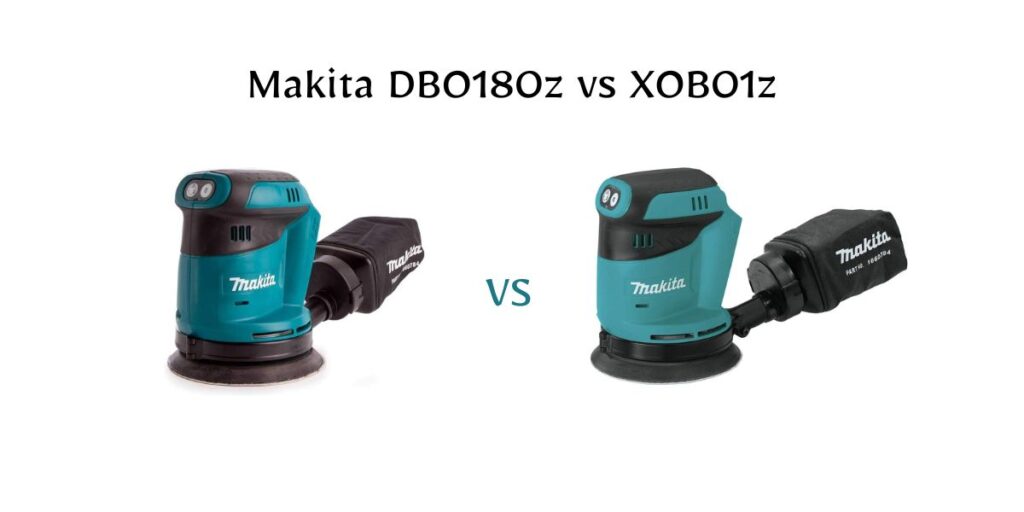
Current Price: $109
- The authorized US listing. Same sander, correct warranty, $29 cheaper.
- Best for furniture finishing, trim work, and anyone already in the Makita 18V LXT ecosystem.
- Tool only — pair with a 4.0Ah or 5.0Ah battery for best runtime.
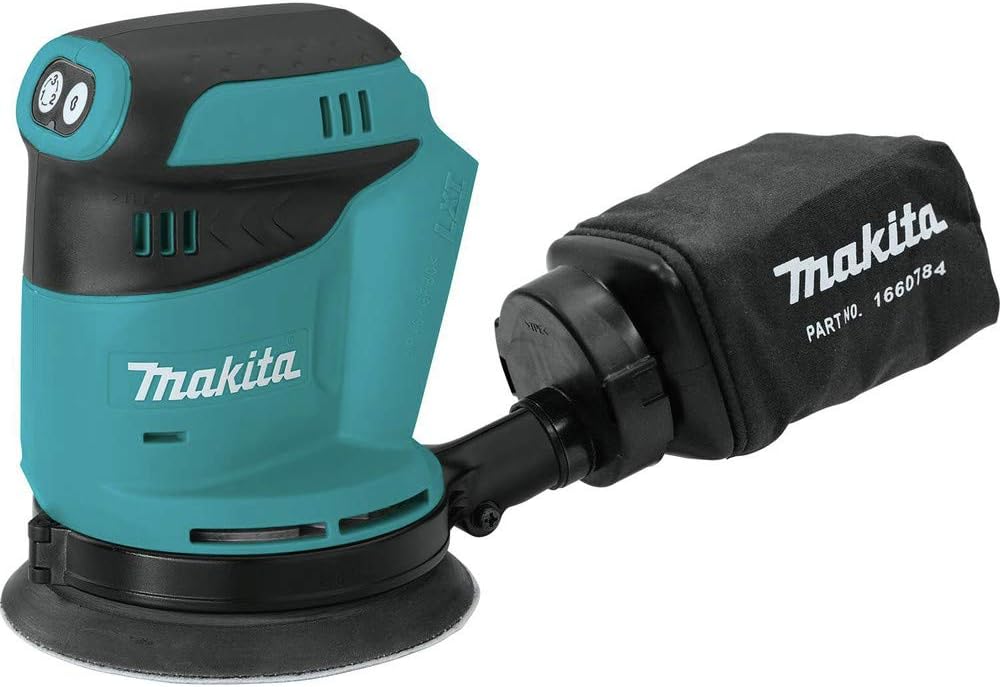

Current Price: $138
- Identical sander, higher price, often sold by an unauthorized reseller.
- No valid reason to choose this over the XOB01Z for US buyers.
- Outside the US? Buy from your local authorized Makita dealer instead.
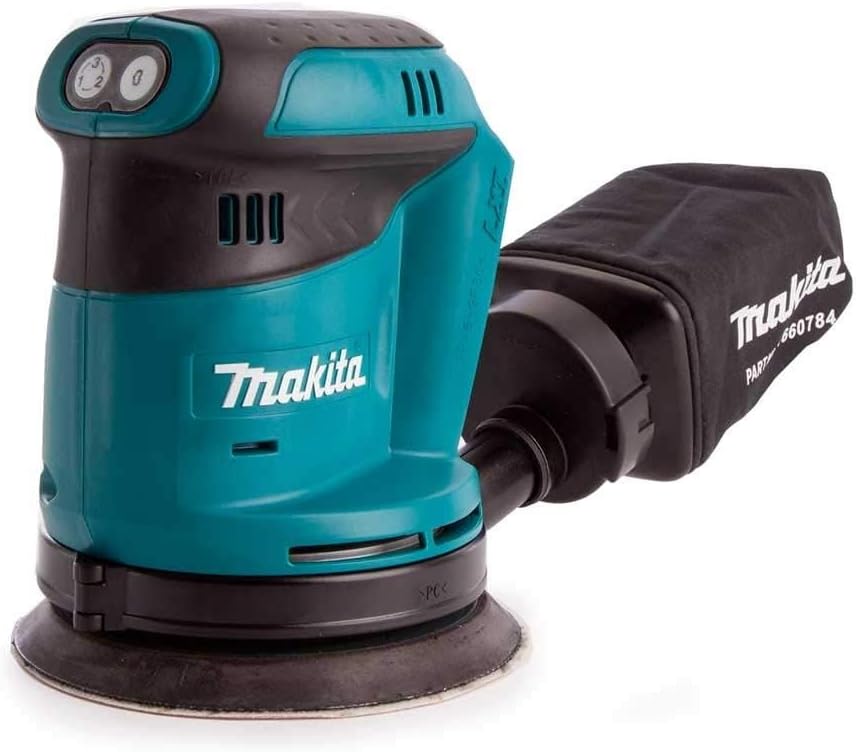
Introduction
You searched “Makita DBO180Z vs XOB01Z” because you saw two listings on Amazon, noticed a $29 price gap, and figured there must be a difference worth understanding.
There is — just not the one you’re expecting. These aren’t two competing sanders with different features, different motors, or different performance levels.
They are the exact same tool, built on the same production line, with the same parts list, sold under two different model numbers because Makita uses regional naming conventions across its global markets.
The DBO180Z is the international designation. The XOB01Z is the US designation. One Amazon listing prices it at $109 through the authorized US seller.
The other prices the identical sander at $138 through a separate entity that is not Makita’s authorized US distributor.
So, this isn’t really a product comparison — it’s a buyer’s warning.
And by the time you finish reading, you’ll know exactly which listing to buy, exactly why the price difference exists, and whether this sander is actually the right tool for your work in the first place.
Table of Contents
TL;DR:
The Makita DBO180Z vs XOB01Z are the same sander sold under different regional model numbers. US buyers should always buy the XOB01Z at $109 — the DBO180Z at $138 is the identical tool sold by an unauthorized reseller at a $29 markup. Same sander, same quality, wrong price.
Related Articles:
At-a-glance: Makita DBO180Z and XOB01Z
| Features | XOB01Z | DBO180Z |
|---|---|---|
| Price | $109 | $138 |
| Seller | Makita Corporation (authorized US) | Often Makita Ltd (unauthorized) |
| US Warranty | ✅ Full 3-year | ⚠️ At risk |
| Speeds | 7K / 9.5K / 11K OPM | Same |
| Pad | 5" hook-and-loop | Same |
| Battery Included | No | No |
| Real Runtime | 20–25 min | Same |
| Verdict | ✅ Buy this | ❌ Skip |
| Where To Buy | Check On Amazon | Check On Amazon |
The Problem Most Buyers Don’t Know They Have
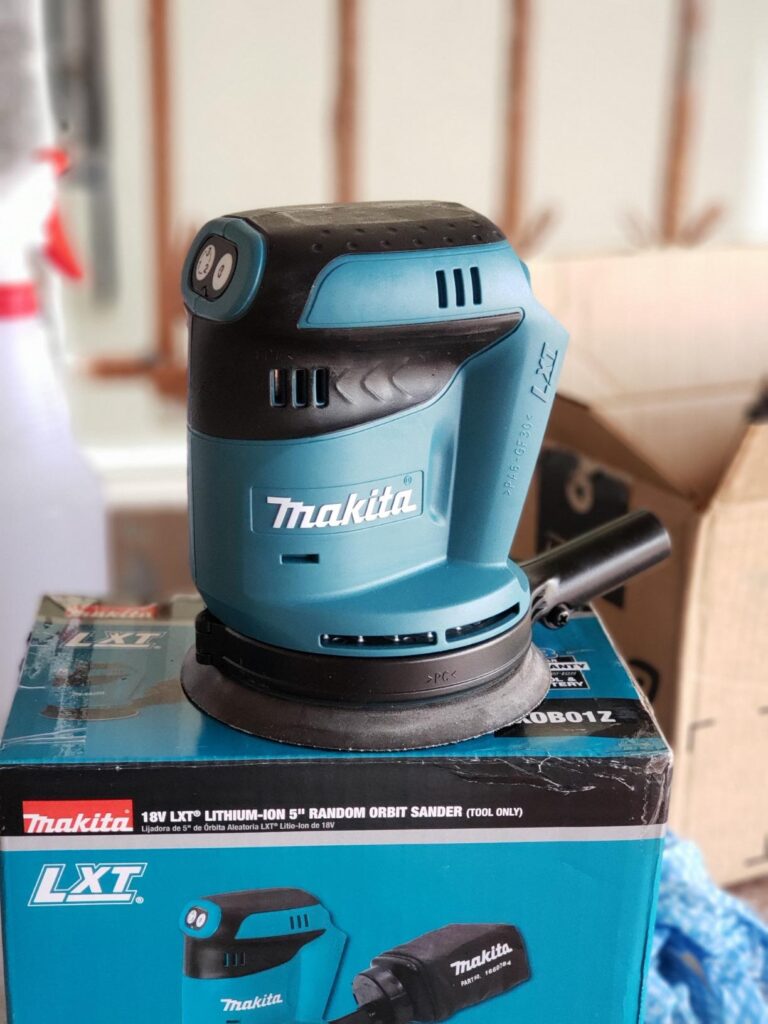
The DBO180Z is the designation used in Canada and international markets. The XOB01Z is the designation used in the United States. Same motor. Same pad. Same speeds. Same dust bag. Same everything. The only thing that changed is the label on the box.
Amazon’s open marketplace allows third-party sellers to list both model numbers simultaneously. This creates a situation where a confused buyer sees two listings for what looks like two different products, one cheaper and one more expensive, and tries to figure out which one is “better.”
There is no better. There is only the correctly priced US listing and the inflated alternative.
Why the Price Difference Exists? (The Seller Problem)
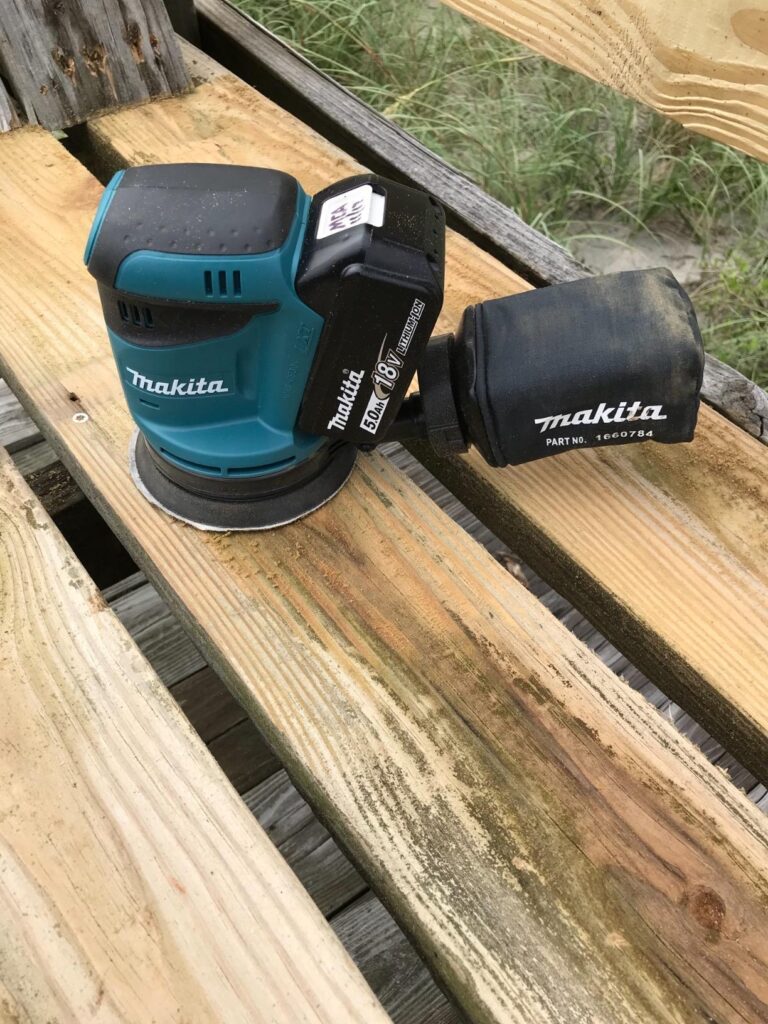
This is the part no other article is telling you clearly, so pay attention.
When you see the DBO180Z listed at $138 on Amazon, look carefully at the seller name. You will often see it sold by “Makita Ltd” — not “Makita Corporation.” These sound like the same company. They are not.
Makita Corporation is the entity authorized to sell Makita products in the United States. Makita Corporation backs those products with a full US warranty and authorized service network.
Makita Ltd is a separate legal entity. It operates as an international seller. When you buy from Makita Ltd on amazon.com, you are essentially buying a product intended for another regional market, sold to you by an unauthorized reseller at a markup.
One Amazon reviewer caught onto this and left a 1-star review that nails the problem precisely: the model number was changed to create the impression of a different product, justifying a higher price. What they received was the same sander, at a $30+ premium, from a seller with a different warranty relationship.
So the DBO180Z on amazon.com at $138 is not a problem of product quality. It’s a problem of seller transparency. The sander itself is fine. The pricing setup is not.
What You Actually Get? (The Sander, Honestly Reviewed)
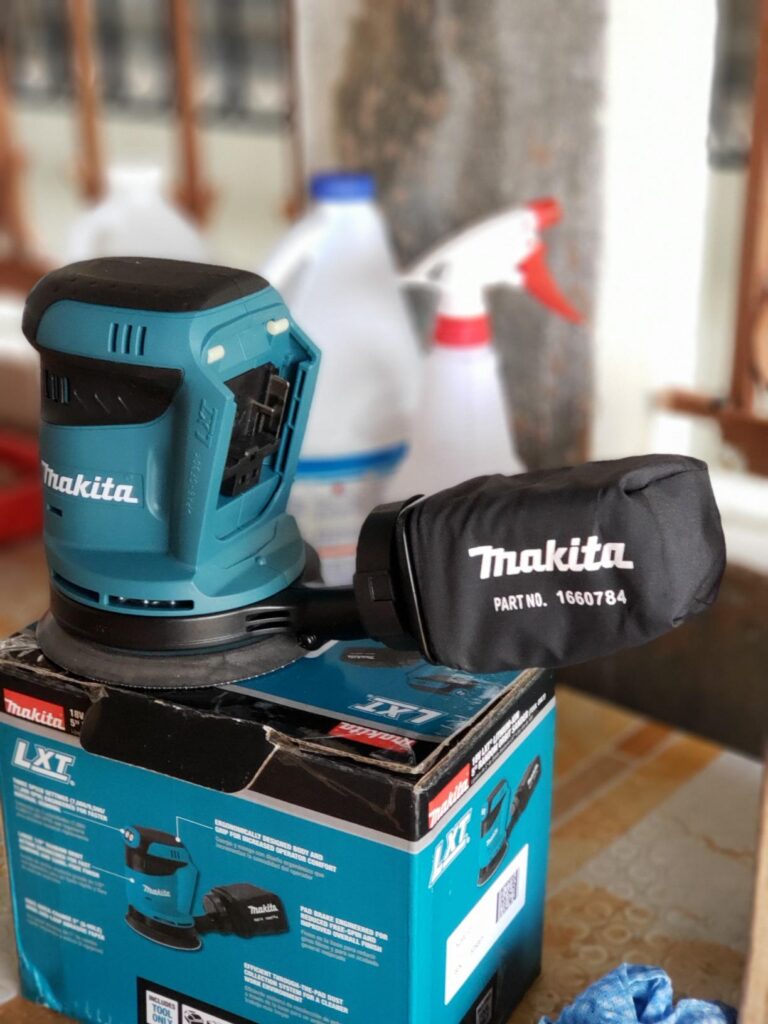
Since both model numbers refer to the same tool, let’s talk about that tool — plainly, without the usual marketing spin.
The Makita 18V LXT Random Orbit Sander (regardless of what you call it) is a genuinely good cordless sander. It is not the best sander ever made. It is not a replacement for a high-powered corded unit. What it is, is a well-built, quiet, capable sander that fits cleanly into the Makita 18V LXT battery ecosystem — which matters enormously if you already own Makita batteries.
The three-speed system runs at 7,000, 9,500, and 11,000 OPM. Most users end up running it at speed 3 for almost everything. Speed 1 is mostly useful for battery conservation on lighter work, not for precision control. That’s a candid reality that the spec sheet won’t tell you.
The pad brake is a genuinely useful feature. It stops the pad within a few seconds of shutdown, which means you’re not accidentally dragging a spinning disc across your finished surface when you set it down.
The noise level is notably lower than most corded sanders in this class. Multiple professional reviews and verified users call this out as a pleasant surprise. If you sand indoors, in a workshop with other people nearby, or just prefer not to wear hearing protection for shorter sessions, this matters.
The dust collection system works well for a built-in bag setup. However — and this is a real issue that keeps appearing in user feedback — the bag can detach during use on some units. The clip connection isn’t as positive as it could be. The fix is simple: make sure the bag is fully seated before you start, or better yet, use the vacuum port with a shop vac. The vacuum port positioning adjusts in 30-degree increments, which is actually a thoughtful design touch that lets you keep the hose out of your working path.
The One Number Makita Doesn’t Advertise Honestly
Makita claims up to 40 minutes of runtime per battery charge. That number is real — if you run the sander at speed 1 on a light material with a fresh 3.0Ah battery under ideal conditions.
In real-world conditions, at speed 2 or 3 on actual wood, with a 3.0Ah battery, you’re looking at 20 to 25 minutes. That’s the number that comes from hands-on testing by multiple credible sources, and it matches what users report on forums and Amazon Q&A sections.
This isn’t a dealbreaker. It’s just honest information you need to plan around. If you’re doing short sessions — sanding a chair, finishing a cabinet door, smoothing out a tabletop — you’ll be fine. If you’re refinishing a deck or sanding a large floor section, you’re going to need multiple batteries, or this is the wrong tool for the job entirely.
For the best real-world runtime, a 4.0Ah or 5.0Ah battery is the sweet spot. The 3.0Ah gets the job done for lighter work and is easier on your wrist. The 5.0Ah gives you the runtime for bigger sessions but adds noticeable weight.
Where This Sander Genuinely Shines?
Cordless freedom is the whole point, and this sander delivers it without the usual trade-offs in quality. Here’s where it earns its place in a shop:
Furniture and cabinetry finishing. This is where the sander is most at home. The low noise, the pad brake, the three speed options, and the manageable weight all work together on detailed finish work where control matters more than raw speed.
Trim and door finishing. Interior trim, door frames, window casings — any situation where a cord is inconvenient and finish quality is important. The cordless format is a real advantage here.
On-site work. If you’re a contractor or woodworker who moves between job sites, the LXT compatibility means this sander shares batteries with your drills, saws, and drivers. One battery system across your whole kit is a legitimate, practical benefit.
Tight spaces and awkward angles. Without a cord to manage, you can get into corners, under stairways, and into spaces where cord management becomes a wrestling match.
Where It Doesn’t Work as Well as You’d Hope?
Large continuous sanding jobs. Multiple users have burned this sander out on extended deck and floor refinishing projects. The motor is not designed for sustained heavy-material removal over long periods. If that’s your primary use, look at a corded unit or a more industrial cordless option.
Speed memory. Every time you turn the sander off and back on, the speed setting does not remember your last position. This is a small thing, but if you’re working in a rhythm and consistently want speed 3, you’ll find yourself checking and resetting frequently. It doesn’t compromise results, but it’s a workflow interruption that accumulates over a long session.
Comparisons to corded at the same price point. A corded sander at $109 will typically deliver higher OPM and more sustained power. You’re paying a premium for cordless convenience. If you don’t have Makita LXT batteries already, factor in the battery cost — it changes the value calculation significantly.
The Decision Framework (Without the Typical Fluff)
Current Price: $109
- The authorized US listing. Same sander, correct warranty, $29 cheaper.
- Best for furniture finishing, trim work, and anyone already in the Makita 18V LXT ecosystem.
- Tool only — pair with a 4.0Ah or 5.0Ah battery for best runtime.
Here’s how to think about this clearly, based on your actual situation:
If you already own Makita 18V LXT batteries, the XOB01Z at $109 is a straightforward, strong addition to your system. The sander is well-built, quiet, and genuinely capable for the work it’s designed for. Buy it.
If you don’t own any Makita batteries yet, you need to add the battery and charger cost to your total. A 4.0Ah battery and charger combo runs around $100–$120. That brings your total to $210–$230 for a complete setup. At that price, you’re in a range where corded alternatives become more competitive unless cordless mobility is important to you.
If you’re outside the US — Canada, UK, Australia, anywhere else — the DBO180Z is likely the correct local listing for your region. Buy from an authorized Makita dealer in your market. Don’t import the US version to save a few dollars; you’ll lose warranty protection.
If you see the DBO180Z listed on amazon.com at $138, close that tab. You’ve already found the XOB01Z at $109. They are the same product. The $29 stays in your pocket.
A Quick Note on Warranty
Makita’s US warranty covers defects in materials and workmanship for three years on tools purchased through authorized US channels. The XOB01Z purchased from Makita Corporation on Amazon falls within this coverage.
The DBO180Z purchased from Makita Ltd on amazon.com may not. Makita Ltd is not the US authorized seller. If you need warranty service, you may find yourself in a difficult position. This is another concrete reason — beyond the price itself — to choose the XOB01Z listing.
What the Spec Sheet Looks Like? (For the Skimmers)
Both models, identical:
Speed settings: 3 speeds — 7,000 / 9,500 / 11,000 OPM Pad size: 5 inches, hook-and-loop, 8-hole, quick-change Orbit diameter: 1/8 inch Battery: 18V LXT Lithium-Ion (not included — tool only) Claimed runtime: Up to 40 minutes (low speed, 3.0Ah, ideal conditions) Real runtime: 20–25 minutes at working speeds Weight: approximately 3.5 lbs without battery Dust collection: Included bag plus vacuum port with 30-degree adjustable hose positioning Pad brake: Yes Speed memory: No
The Bottom Line
The Makita DBO180Z and XOB01Z comparison exists because Amazon’s marketplace creates the illusion of a choice where no real choice exists. Two model numbers, one sander, one right answer.
If you’re in the US: buy the XOB01Z at $109 from an authorized seller. You get the same tool, the correct warranty coverage, and $29 back in your pocket. There is no scenario in which buying the DBO180Z on amazon.com at $138 makes sense for a US buyer.
If the sander itself is right for your needs — cordless freedom, the Makita LXT ecosystem, quiet operation, furniture and finish work — it’s a genuinely good tool at a fair price. It’s not a heavy-duty production sander. It’s not a budget throwaway either. It sits squarely in the “reliable, practical, well-made” category for the work it was designed to do.
The only question worth asking isn’t DBO180Z or XOB01Z. It’s whether this sander, at this price, fits your actual work. Based on everything above, you now have enough to answer that honestly.
FAQs
Is the Makita DBO180Z the same as the XOB01Z? Yes. Identical tool, identical parts, identical specs. Different model numbers for different regional markets.
Why is the DBO180Z more expensive on Amazon? It’s often sold by “Makita Ltd” — not the US-authorized “Makita Corporation.” Same sander, different seller, inflated price.
Which one should I buy in the US? The XOB01Z at $109, always. It’s the authorized US listing with full warranty coverage.
Does the battery come included? No. Both are tool-only listings. You need a separate 18V LXT battery and charger.
How long does the battery actually last? About 20–25 minutes at working speeds — not the 40 minutes Makita advertises (that’s a low-speed lab figure).
Is this sander good for large jobs like decks? No. It’s built for furniture, trim, and finish work. Extended heavy sanding will overheat the motor.